
Concertina Wire and Concertina Coil Manufacturer
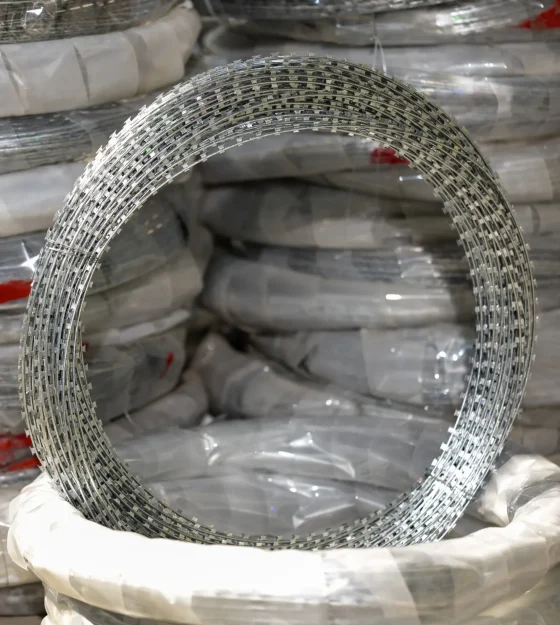
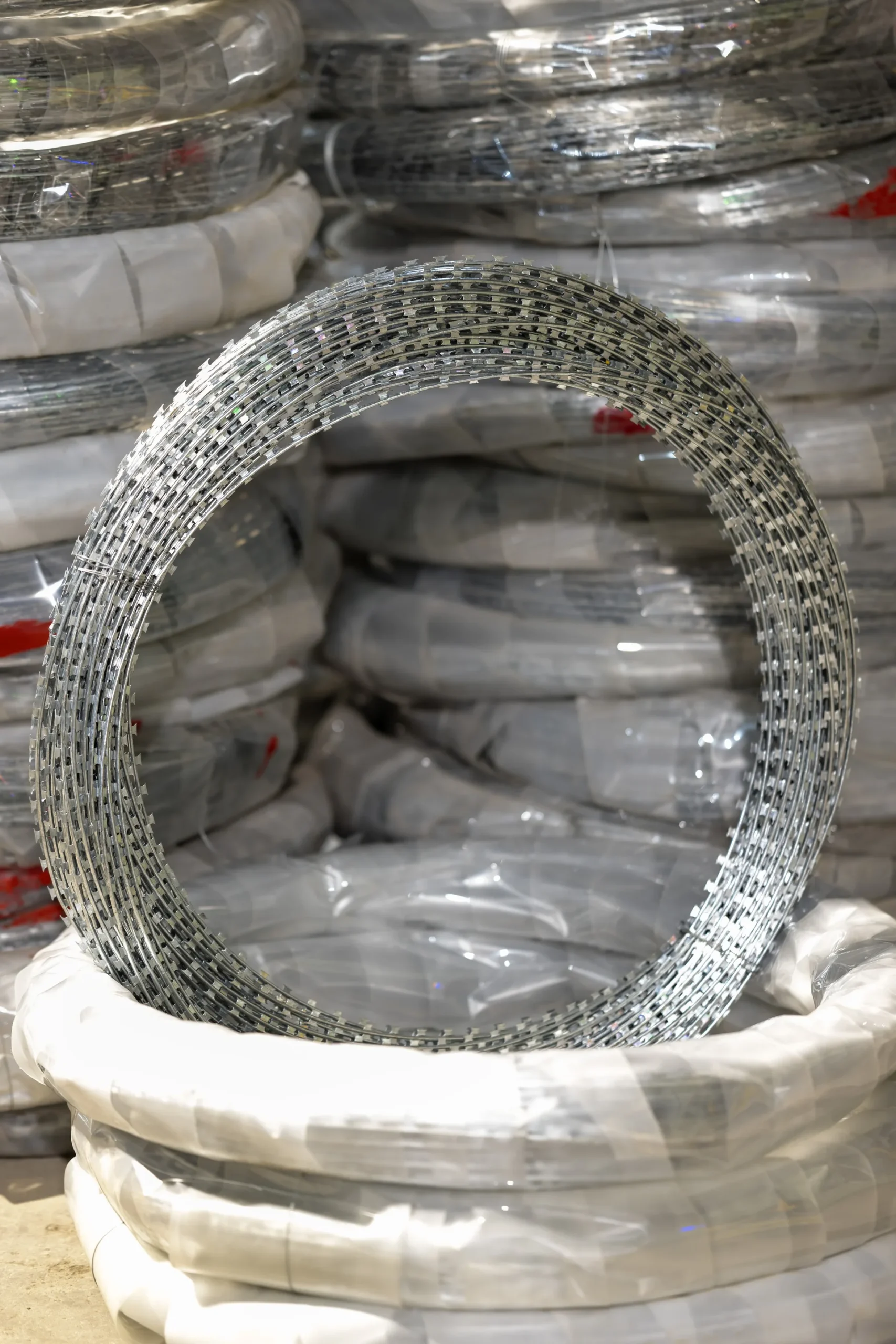
Concertina wire, also known as concertina coil or razor wire coil, is a spiral perimeter barrier made from razor-punched steel tape crimped onto a high-tensile spring steel core wire. We manufacture this product at our Raipur facility using hot-dip galvanised materials, offering the full blade profile range from BTO-10 to CBT-65 and coil diameters from 450 mm to 1050 mm, in both single-coil and cross-coil configurations. Please provide the coil type, blade profile, coil diameter, coating weight, and quantity for a quotation.
Why a Boundary Wall With Barbed Wire on Top Is Not a Secure Perimeter
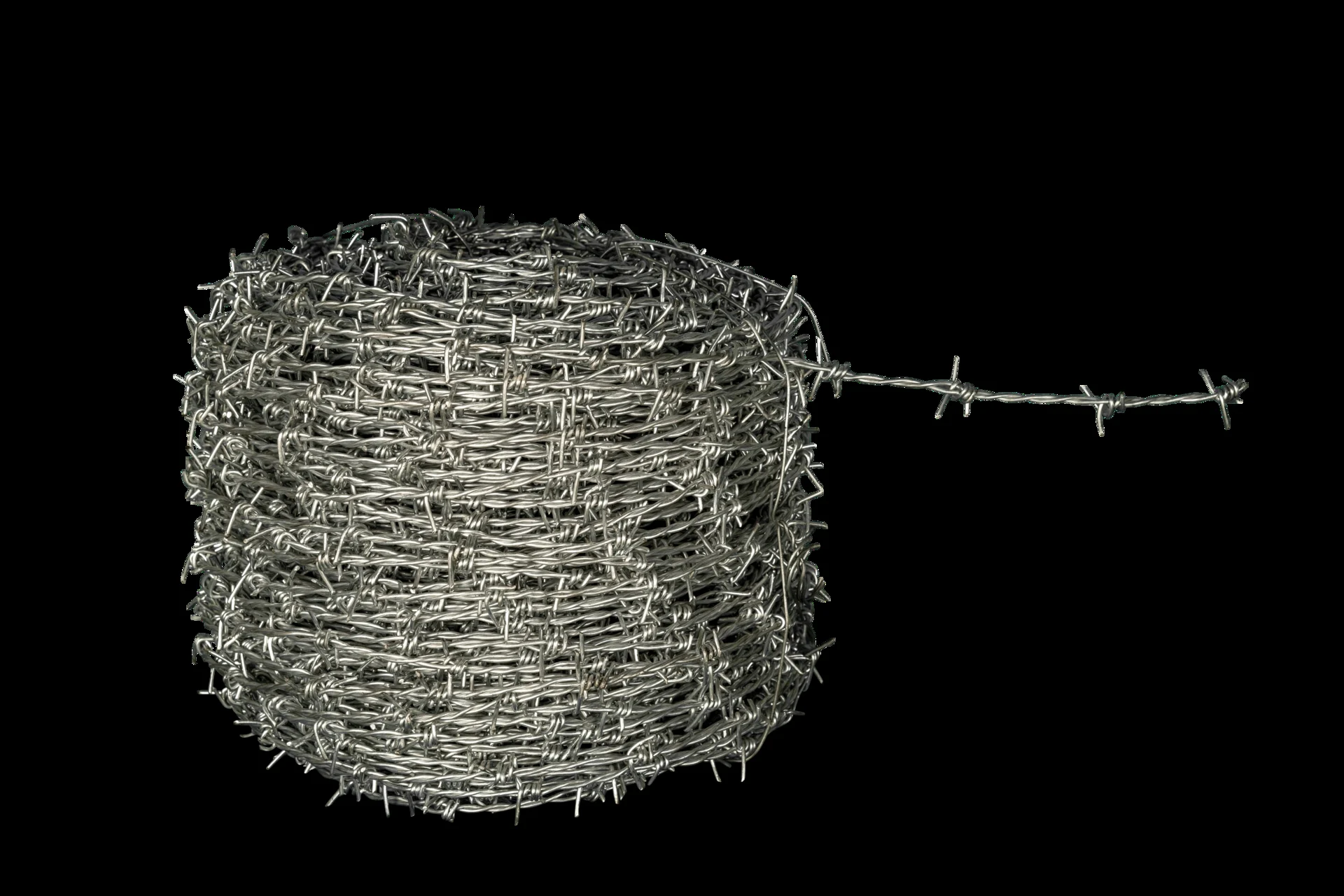
Barbed wire marks property boundaries. This function is sufficient for farm perimeters or cattle enclosures.
However, barbed wire is not a security barrier. It is easily breached with basic tools or improvised methods, offering only minimal delay to intruders.
Concertina wire is designed to delay intrusion rather than simply mark a boundary. In high-security applications, it has largely replaced barbed wire because it is significantly more difficult and time-consuming to breach, allowing security personnel time to respond.
This is the principle behind perimeter security: no barrier is impenetrable, but the objective is to create sufficient delay between an intrusion attempt and entry, enabling an effective security response.
If your site has a wall topped with barbed wire, it is not necessary to rebuild the wall. Instead, consider upgrading the barrier on top.
What Concertina Wire Actually Is, Component by Component
Concertina wire is a type of razor wire formed into a helical spiral. It is also called concertina coil, razor wire coil, concertina barbed tape, or, in older military literature, Dannert wire. The name derives from the musical instrument, as the coil arrives compressed and expands like an accordion during installation.
Concertina wire is part of the razor wire family, which includes straight-line razor wire and razor wire mesh, and offers greater security than barbed wire. It is used independently at ground level or as a topping on chain-link fences, welded wire mesh, and boundary walls. Military applications often combine it with barbed wire and steel pickets. It is standard for prisons, detention facilities, riot control barriers, and international borders.
Three components determine a concertina coil’s performance.
The core wire resists cutting and allows the coil to return to its original shape.
A high-tensile spring steel wire of 2.5 mm runs continuously through the tape. This is the load-bearing element, and it does two separate jobs.
First, it resists cutting. Unlike mild steel used in ordinary barbed wire, high-tensile spring steel is harder, tougher, and significantly more difficult to cut.
Second, it provides the coil with elastic memory. When compressed, high-tensile wire returns to its original shape. This elastic recovery, determined by tensile strength, distinguishes concertina wire from barbed wire.
Our core wire is supplied at 1500-1700 N/mm² minimum tensile strength, against a spring steel wire specification, and we hold mill test certificates for it.
Why tensile strength is the specification most often substituted
A concertina coil with a mild steel core wire appears identical to one made with spring steel. The tape, blade profile, galvanised finish, coil diameter, and weight are nearly the same, making visual differentiation impossible.
The difference becomes clear in use. Mild steel does not recover its shape; once compressed, the affected section remains flat, compromising the barrier. Additionally, mild steel coils tend to sag between brackets over time.
Therefore, consider the following:
- Specify a minimum tensile strength in N/mm² in your requirements, rather than using only the term “high tensile,” which is descriptive but not quantitative.
- Request the mill test certificate for the core wire and verify the tensile strength against your specification, not just the supplier’s brochure.
- Confirm whether the tensile strength is measured before or after galvanising. A supplier who can answer this accurately demonstrates material knowledge.
If a quotation is significantly lower than others and the coating specification is correct, review the core wire specification next.
The blade tape provides the primary deterrent against manual intrusion.
A cold-rolled steel strip is punched with sharp blade profiles and crimped securely around the core wire. Proper crimping is as important as blade sharpness, as it prevents blades from sliding or rotating and maintains barrier integrity.
Blade profiles are internationally standardised, ensuring that a designation such as BTO-22 refers to the same specification regardless of location.
The coating determines the product’s durability and service life.
Both the core wire and blade tape are hot-dip galvanised. Zinc provides sacrificial protection to steel, and the duration of this protection depends primarily on the coating weight, measured in grams per square metre.
Coating weight is often under-specified in concertina procurement. The term “GI” on a quotation does not indicate service life; for example, both 80 g/m² and 275 g/m² are considered galvanised but offer different levels of protection.
The Spiral Is Doing More Work Than the Blades
A straight run of razor tape can be pushed down or bridged. A spiral cannot, due to its geometric design rather than its material properties.
Push one loop of a concertina coil and the adjacent loops rotate inward and close around the pressure point. No rigid frame to grip, no stable foothold, and every surface presents blades.
On a cross-type coil, galvanised clips bind alternate loops, so the whole coil behaves as one interconnected cylinder rather than a series of independent rings. You cannot part it by hand, and cutting through means cutting several clipped loops in sequence.
Procurement teams often underestimate this point. Cutting a cross coil requires multiple cuts, often in awkward positions, creating noise and a moving barrier.
Get These Four and the Rest Is Just Quantity
Most enquiries begin with “send me a rate for concertina wire.” This question cannot be answered directly, as there is no single standard product.
Please consider the following decisions in order, as each choice affects the next.
- Coil type — single or cross. Set by your security requirement.
- Blade profile — BTO-10 through CBT-65. Set by the threat level, and by the tender if there is one.
- Coil diameter — 450 mm to 1050 mm. Set by where it is mounted and how much boundary each coil must cover.
- Coating weight — the zinc mass in g/m². Set by how long the barrier has to last and how aggressive the atmosphere is.
After these, determine quantity and required documentation.
Single Coil or Cross Coil? This Is the Security Decision
| Construction | One continuous spiral, no clips | Alternate loops bound with galvanised clips |
| Behaviour when opened | Natural, independent loops | Rigid interconnected cylinder |
| Can it be parted by hand? | Loops can be separated | No — clips hold the geometry |
| Appearance | Lower visual impact | Visibly aggressive |
| Installation | Simpler and faster | Slower, more fixing points |
| Recoverable and redeployable | Yes | Partially |
| Typical use | Farm boundaries, temporary barriers, low to medium risk sites | Prisons, defence installations, critical infrastructure, high-risk industrial |
| Relative cost | Lower | Higher |
The industry recognizes the practical differences: single coil installs without clips, runs in natural loops on a wall or fence, appears less intimidating, and is easier to install. Cross type binds two coils together with clips and forms an intersecting structure when opened.
Select single coil for deterrence and exclusion of animals or opportunistic intruders. Choose cross coil to withstand deliberate, tool-assisted intrusion attempts.
If you are unsure which option is appropriate for your site, contact us with your boundary length, wall height, and details of what you are protecting. We will recommend the most suitable specification.
Which Blade Profile? The Number Is the Barb Length
Blade profiles use a two-part code. BTO stands for Barbed Tape Obstacle — the shorter blade family. CBT stands for Concertina Barbed Tape — the longer blade family. The number that follows is the nominal barb length in millimetres.
Longer blades reach further, cut deeper, and provide greater visual deterrence. Shorter blades are spaced closer together, creating a denser cutting surface across a shorter span while using less steel per metre. Neither option is universally better; each addresses different security needs.
We manufacture across the full range.
Profile | Blade family | Nominal barb length | Commonly specified for |
| BTO-10 | Short | 10 mm | Economy fencing, cross-type coils where blade density matters more than reach |
| BTO-12 | Short | 12 mm | Commercial boundaries, lower-risk perimeters |
| BTO-18 | Short to medium | 18 mm | Commercial and light industrial perimeters |
| BTO-22 | Medium | 22 mm | The most widely specified profile — factories, warehouses, solar parks, industrial perimeters |
| BTO-28 | Medium to long | 28 mm | Higher-risk industrial and institutional perimeters |
| BTO-30 | Medium to long | 30 mm | Higher-risk industrial, storage and institutional perimeters |
| CBT-60 | Long | 60 mm | Defence, prisons, critical infrastructure |
| CBT-65 | Long | 65 mm | Defence, border, prisons, critical infrastructure |
Why we publish our own figures rather than a generic table
This is important to know before comparing quotations. BTO and CBT are trade designations, not standards. No Indian or international standard defines these dimensions, and published figures for the same profile can differ between manufacturers, particularly in barb width, spacing, and sometimes tape thickness.
Two suppliers may both quote “BTO-30” in good faith but deliver measurably different tape. If your specification or tender only names a profile code, the product is not fully specified.
For this reason, our table lists our own dimensions with tolerances rather than using a generic industry chart, and we include profile dimensions on our quotation and technical submittal. If your BOQ specifies a profile, please inform us. If it also specifies dimensions, we will confirm line by line whether our product meets them before you place the order.
Choosing between them
If your BOQ names a profile, we work to the BOQ.
If it does not, base your choice on the threat rather than the catalogue. A longer blade is not always an upgrade. For example, on a low wall in a residential-adjacent commercial estate, 65 mm blades overhanging a public footpath are a liability. On a border or a magazine perimeter, they are appropriate. Tell us what you are protecting and where the barrier is located, and we will recommend a profile.
If Your Tender Uses a Different Name for the Same Thing
Every concertina coil in the Indian market is described as galvanised, but most do not specify the zinc coating weight. This is often the source of price differences.
Hot dip versus electro-galvanised: Hot dipping immerses the material in molten zinc, resulting in a heavier, more durable deposit. Electro-galvanising applies a thin layer electrically, which is less expensive and suitable only for temporary barriers. Both can be described as “galvanised” on a quotation.
We manufacture only from hot-dip galvanised tape and core wire. If a competing quotation is significantly cheaper, first check whether it is electro-galvanised, as this is often the reason.
Regarding quality control: We do not operate a galvanising line. The zinc coating is provided by our material supplier according to the specified coating weight at purchase, and we verify it upon receipt. We include supplier coating weight test records with each consignment.
We control all subsequent manufacturing variables: blade profile, coil diameter, loop count, clip count and spacing, crimping, and the pitch at which the coil is set to open. These factors determine barrier performance and whether your coil count covers your boundary.
This distinction is important when comparing suppliers. A manufacturer who claims the zinc is theirs either operates a galvanising plant, which is rare in this industry, or is not being precise.
Galvanised steel is not suitable for all environments. In heavy coastal air, near chemical and fertiliser plants, or in atmospheres with chloride or acidic deposition, zinc is consumed faster than it can protect. In these cases, stainless steel is the correct specification. We do not supply stainless steel concertina wire. If your site requires it, specify SS304 and source accordingly. The risk is premature coil failure, not just a higher purchase price.
We do not publish a service life in years. Actual lifespan depends on zinc mass, local atmospheric corrosivity, and installation handling. Any figure quoted without these variables is marketing rather than engineering.
A Bigger Coil Is Not Automatically the Right Coil
Coil diameter | Where it is normally used |
450 mm | Wall-top on boundary walls; inner row inside a ground pyramid |
600 mm | Wall-top and fence-top on commercial and industrial perimeters |
900 mm | Fence-top on chain link and welded mesh; higher-risk wall tops |
1050 mm | Ground-laid barriers, pyramid stacks, defence and border perimeters |
Two issues arise when buyers over-specify coil diameter.
Overhang. A 1050 mm coil on a boundary wall projects well beyond the wall line. If your wall runs along a public footpath or a neighbour’s plot, that overhang is a legal and safety problem before it is a security one.
How Much Boundary Does One Coil Actually Cover?
This question is essential for your BOQ, but is often overlooked. The calculation is as follows:
A coil’s coverage depends on two factors: the number of loops and the distance between them when stretched.
Covered length = number of loops × loop pitch
Loop pitch is the centre-to-centre distance between adjacent loops when the coil is opened. Increasing the pitch covers more boundary but creates wider gaps and reduces security. For this reason, specifications typically limit the pitch rather than the total length.
General installation specifications typically require coil spacing of approximately 12 inches, with a ±2 inch tolerance. Defence-grade specifications are stricter, limiting coils to a maximum stretched length of 10 metres and capping the gap between coil openings at 18 cm for outer 1050 mm rows and 9 cm for inner 450 mm rows.
For example, consider a coil with 53 loops.
- Opened at 250 mm pitch: 53 × 0.25 = 13.25 m covered
- Opened at 300 mm pitch: 53 × 0.30 = 15.90 m covered
This results in 20% more boundary coverage from the same coil, but with a 50 mm wider gap between each loop. If a supplier’s coverage figure seems unusually high, the assumed pitch is likely the reason. Always confirm the pitch used.
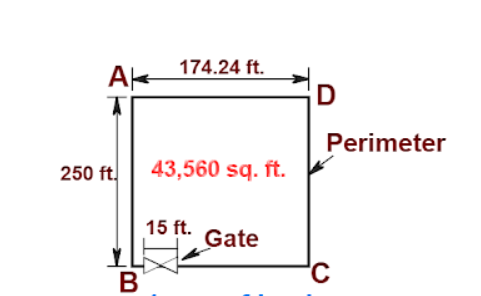
Estimating your requirement:
Coils required = boundary length ÷ (covered length per coil − overlap)
Allow for approximately one loop of overlap at each coil joint. Include additional coils for gates, corners, and returns, as these areas require more material than straight sections.
If you do not have a boundary measurement, our calculator can convert land area in acres or square feet into an approximate perimeter. This provides a basis for an initial estimate.
Coil diameter | Covered length at specified pitch |
450 mm | 4.5 m |
600 mm | 6 m |
900 mm | 9 m |
1050 mm | 10 m |
Coverage is specified at a defined loop pitch. We confirm both loop count and pitch on the quotation to ensure your BOQ matches the delivered product.
If you have the boundary length and wall height, please contact-us. We will provide a recommended coil count in addition to pricing.
Coil Weight, and Why Your BOQ Should Carry It
Weight is important for two reasons: freight and verification. A coil that weighs significantly less than specified contains less steel, which may indicate thinner tape, lighter coating, or fewer loops.
Coil Diameter | Weight per coil |
450 mm | 5.6 – 6 kg |
600 mm | 7.6 – 8 kg |
900 mm | 10 – 11 kg |
1050 mm | 12.5 – 13 kg |
Weight varies with loop count, blade profile, clip count, and coating weight, so a single figure per diameter is only an approximation. We state exact weights on the quotation and dispatch documents for verification at the weighbridge.
If your BOQ is specified per kilogram rather than per metre or per coil, please inform us at the enquiry stage. This affects how the quotation is prepared.
Wall Top, Fence Top or Ground: Three Different Installations
These are distinct installation methods, each requiring different fixings, diameters, and quantities.
On a boundary wall
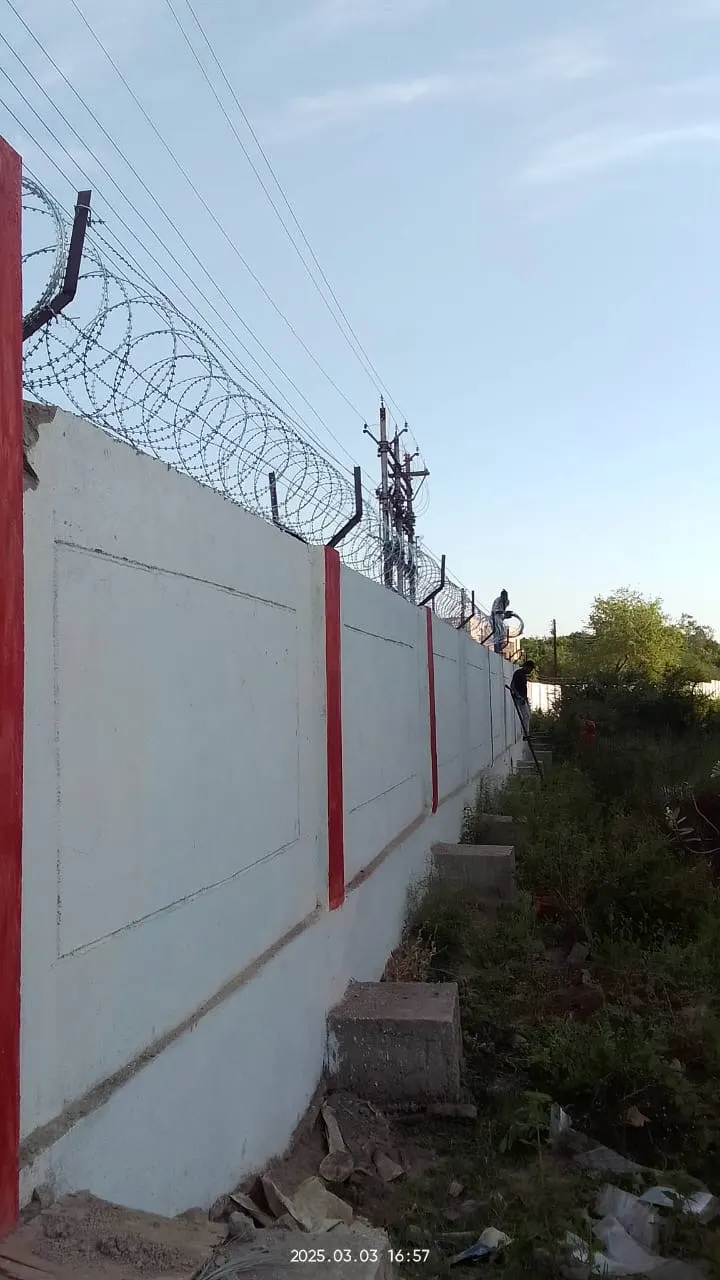
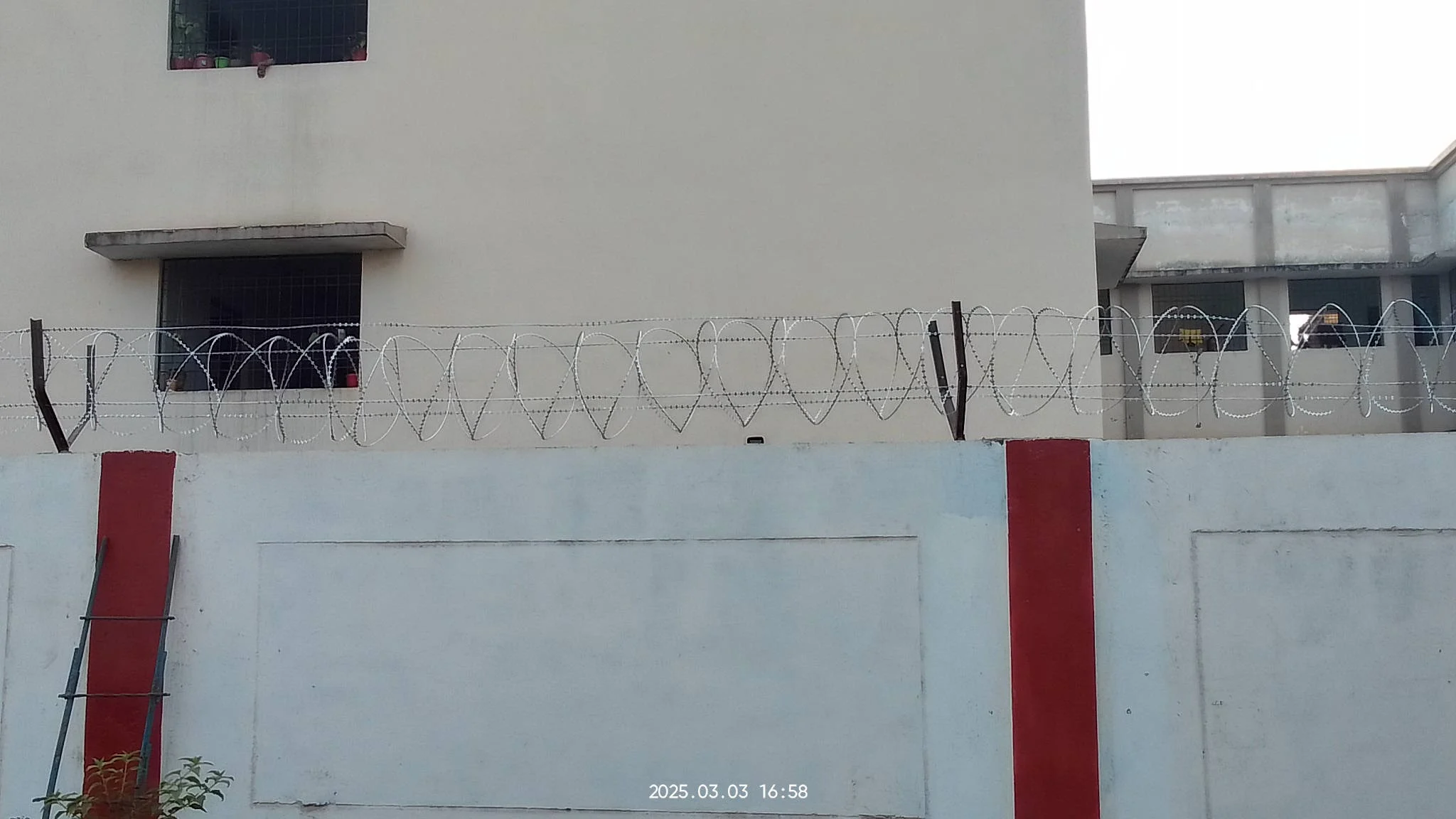
Angle brackets or Y-arms are fixed along the wall top, and the coil is stretched between them. Brackets are typically set at 3 to 4 metre intervals, with the coil secured to each bracket at two points using 2 mm tie wire. Adjacent coils are joined at two diametrically opposite points.
A sound wall requires no civil rework. However, a wall that is cracked, built with hollow blocks without a capping beam, or already leaning will require reinforcement. The coil adds both dead load and wind load along the top, so brackets must be anchored into solid material.
On an existing fence
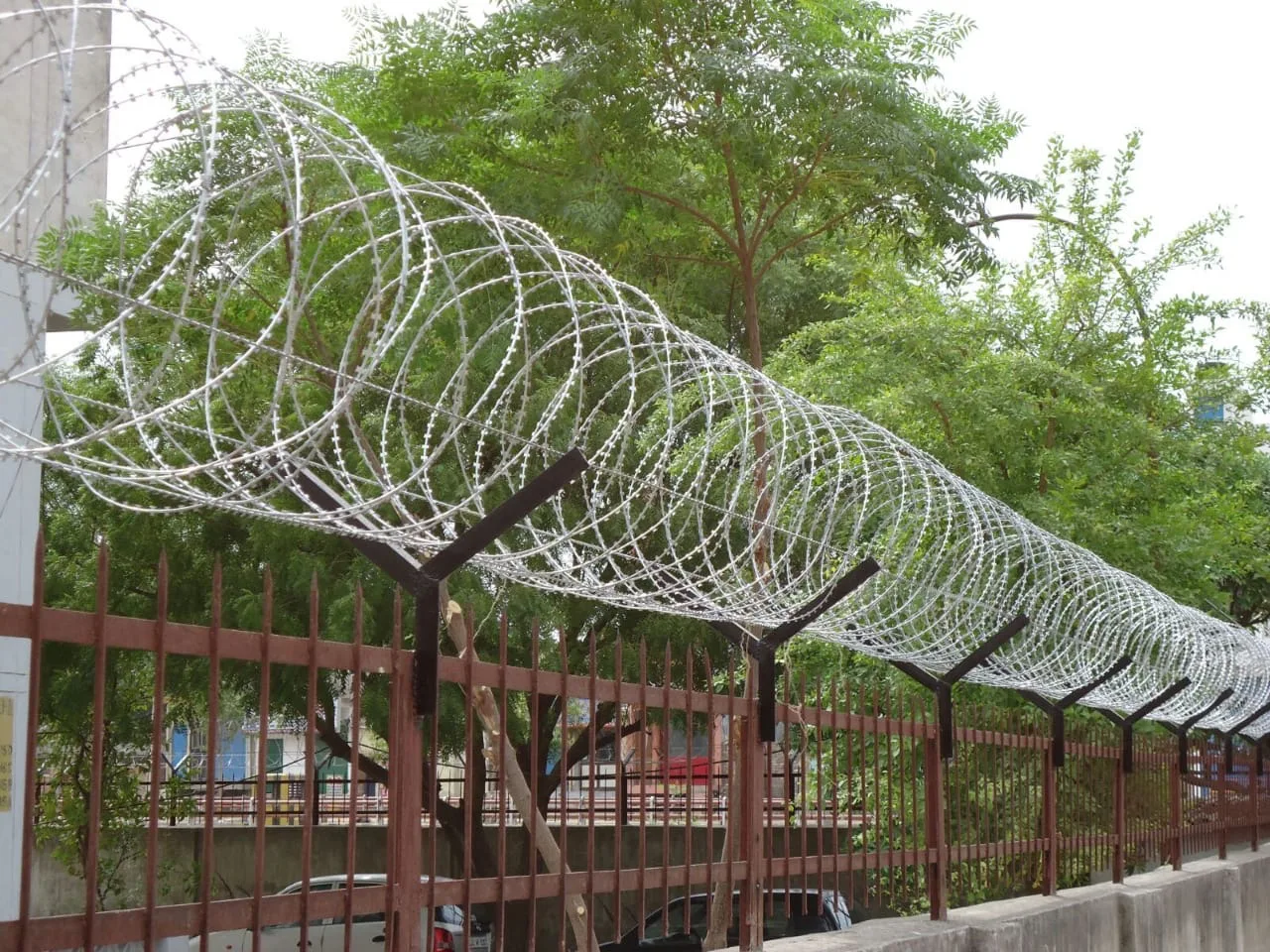
Y-arms or V-arms are bolted to existing posts, and the coil runs along the top. Attach the coil to the fence approximately every foot and to the adjoining coil every four feet, using hog rings or stainless steel rebar ties. Rebar ties reduce vibration but require more installation time.
This is the most common upgrade. An existing Chain-link fence or welded wire mesh perimeter gains effective anti-climb protection without altering the fence structure.
On the ground
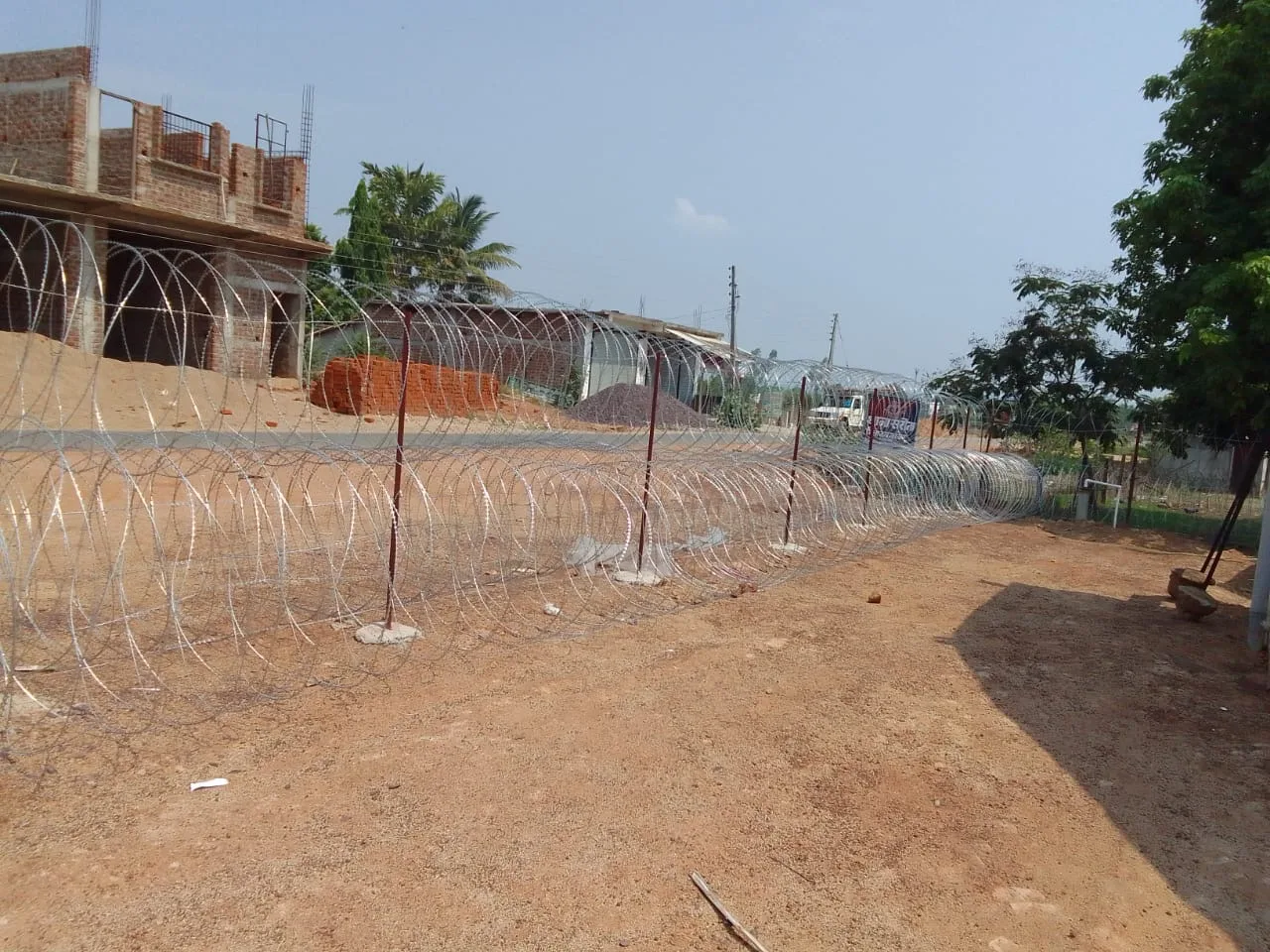
Ground deployment can be a single run, a run laid on top of another coil, or a pyramid. The standard arrangement is a triple stack: two coils at the base and one on top, with coil ends joined by quick-links or carabiners to form a continuous barrier. Defence specifications require anchor rods, typically 8 mm in diameter and 250 mm long, at intervals of no more than 5 metres, to secure the lower coils to the ground.
Without anchoring, a ground-laid coil can be moved aside. Anchoring transforms it from an obstacle into a true barrier.
Safety and signage
Concertina wire can cause serious lacerations. Use cut-resistant gloves and sleeves, and keep the work area clear during installation. Warning signage is recommended at intervals of approximately 10 metres along the run, and should be considered mandatory on any perimeter accessible to the public.
Municipal bye-laws and housing society rules may restrict razor wire on street-facing walls in some areas. Check local regulations before installing on a residential boundary.
Where Concertina Wire Is Specified
- Defence and border security — border fencing, military installations, ammunition depots, cantonment perimeters
- Transport infrastructure — airports, railway yards and track protection
- Power and energy — solar parks, substations, thermal and hydro plants, transmission infrastructure
- Industrial — factories, mining sites, cement and steel plants
- Storage and logistics — warehouses, cold storage, fuel depots, bonded storage
- Institutional and government — prisons, courts, government offices, water treatment plants
- Commercial and residential — commercial boundary walls, gated communities, farmhouses
- Agriculture — farm boundaries, orchards, livestock and poultry enclosures
In our supply region, we supply the largest volumes to solar parks, the industrial belt around central India, railway contracts, and warehouse projects. There is also steady demand from farm owners in Chhattisgarh and Madhya Pradesh who use single-coil at ground level to prevent wild boar and cattle intrusion on boundaries where plain barbed wire has failed.
Full Technical Specifications
Parameters | Specifications |
Blade profiles manufactured | BTO-10, BTO-12, BTO-18, BTO-22, BTO-28, BTO-30, CBT-60, CBT-65 |
Blade dimensions | Per profile — see the profile table above |
Core wire diameter | 2.5 ±0.1 mm |
Core wire material | High tensile spring steel, to a spring steel wire specification |
Core wire tensile strength | 1500 – 1700 N/mm² minimum |
Material | Hot-dip galvanised tape and core wire |
Coating weight | 80 – 100 g/m² standard |
Stainless steel option | Not offered |
Coil diameters offered | 450 / 600 / 900 / 1050 mm |
Coil types | Single spiral, cross (clipped) |
Loops per coil | Stated per diameter, profile and coil type on quotation |
Covered length | Stated per diameter, coil type and loop pitch on quotation |
Packing | Compressed coil, wrapped, with carrying handles |
Customisation | Blade profile, coil diameter, loop count, clip count, coating weight |
Have a BOQ or a tender specification? Contact us and we will confirm, line by line, what we can match and what would need substitution.
What Actually Drives Concertina Wire Price
Concertina is quoted per coil, per running metre, or per kilogram, depending on how the BOQ is written. These units are not interchangeable, which is why quotations that appear very different are often equivalent in price.
Five variables move the number:
- Blade profile. CBT-65 is more expensive than BTO-22 due to its thicker tape and higher steel content per metre.
- Coil diameter and loop count. More loops and a larger diameter increase the material used per coil. Two 600 mm coils with different loop counts are distinct products.
- Coating weight. Heavier zinc coatings cost more than lighter ones. Electro-galvanised options are less expensive but have a significantly shorter lifespan.
- Coil type. Cross-type coils are more expensive than single spiral coils because the clips require additional material and labor.
- Quantity. Project and tender volumes are priced in slabs, while dealer terms are handled separately.
To compare two quotations accurately, convert both to the cost per running metre of the installed, specified boundary. Request from each supplier: blade profile, coil diameter, loop count, assumed loop pitch for coverage, coating type and weight in g/m², and coil weight.
If a quotation lacks loop count or coating weight, it cannot be properly compared. These omissions often conceal key differences.
Published market rates for concertina wire vary significantly and fluctuate with steel and zinc prices. Treat online figures as general indications rather than benchmarks.
What "Conforms to IS" Really Means on a Concertina Quotation
This point requires clarification, as it is frequently misrepresented in the market.
There is no Indian Standard for the finished razor tape concertina coil as a product. Manufacturers use international references and BIS-certified raw materials. Indian Standards apply only to the input materials: the core wire, the strip, and the galvanising.
Therefore, when a supplier states “conforms to IS”, you should ask which specific component is being referenced.
Components | What the reference covers |
Core wire | High tensile spring steel wire specification |
Punched tape | Cold-rolled / galvanised steel strip specification |
Zinc coating | Hot dip galvanising coating requirements and test method |
Clips | Structural steel grade |
Blade profile | International BTO / CBT designation, not an Indian Standard |
We specify the standard and grade for each component in our quotations and technical submittals, and provide material test certificates with institutional and tender orders. We do not label finished coils as “IS certified,” since no such certification exists for this product. An informed inspector may view such claims as grounds for closer scrutiny.
Our quality management system is certified to relevant standards and covers all processes from incoming material inspection to final packing.
What You Should Check Before Accepting a Consignment
Perform these checks at the gate before releasing the vehicle.
- Weigh the consignment and compare it to the coil weight listed on the dispatch document. Any shortfall indicates less steel, which could mean lighter tape, thinner coating, or fewer loops.
- Randomly count the loops on two or three coils and compare them to the quotation. Loop count is the variable most frequently reduced without notice.
- Fully open one coil and measure the pitch. This confirms whether the coil count will adequately cover the boundary.
- Measure barb length, width, and spacing against the dimensions specified in the quotation, not the profile code. Profile codes are not standardized, so the code alone is insufficient for verification. For BTO-22, expect 22 ±1 mm barbs, 15 ±1 mm wide, at 34 ±1 mm spacing; for CBT-65, 65 ±2 mm at 100 ±2 mm. For other profiles, use the quoted figures.
- Check the coating. Hot-dip galvanising has a visibly heavier and less uniform finish than electro-galvanising. If the specification requires hot-dip, request the coating weight test record.
- Check the core wire tensile certificate. This specification cannot be verified visually, by measurement, or by weighing. Mild steel coils look identical to spring steel coils but do not spring back once flattened. Request the mill test certificate at the order stage.
- Test the spring-back by pressing a section of the coil flat by hand and releasing it. High tensile core wire will recover its shape. If the section remains flat, halt the consignment and request the wire certificate.
- Check the crimping by attempting to slide a blade along the core wire by hand. The blade should remain fixed.
- Inspect the clips on cross-type coils. Count the number per turn and confirm they are galvanised, not bare.
- Inspect the packaging for transit damage and ensure the carrying handles are intact. Damaged coils pose handling risks.
Request these records at the order stage, not at delivery. A supplier unable to provide a coating weight test is signalling a potential issue.
Send Us These Details and We Can Quote the Right Specification
- Coil type — single spiral or cross (clipped)
- Blade profile — BTO-10 to CBT-65, or the designation used in your tender
- Coil diameter — 450 to 1050 mm
- Coating weight — the required zinc mass in g/m²
- Core wire tensile strength — the minimum N/mm² your specification requires
- Quantity — boundary length in running metres, or number of coils
- Installation type — wall top, fence top, or ground (and pyramid rows if applicable)
- Delivery location — for freight
- Documentation required — material and mill test certificates, coating weight reports, certificates for tender submission
Manufacturing Concertina Wire in Raipur Since 1995
We have manufactured wire and fencing products in Raipur for three decades. Concertina coils, welded wire mesh, Chain-link fence, and barbed wire are all produced in the same facility, allowing us to offer a complete perimeter package from a single vendor on a unified schedule.
How we work on concertina specifically:
- We purchase materials to specification rather than price. Hot-dip galvanised tape and core wire are procured according to specified coating weight and wire grade, verified upon receipt, and supported by test records provided to you.
- Coils are manufactured to your configuration. Blade profile, coil diameter, loop count, clip count, and clip spacing are set according to your drawing or BOQ, not a fixed catalogue.
- Loop count and pitch are explicitly stated in the quotation, ensuring the coverage figure in your BOQ matches the actual site coverage.
- We provide documentation for institutional procurement, including material test certificates, coating weight records, and ISO 9001 certified quality management.
- We have strong regional supply capabilities across Chhattisgarh, Madhya Pradesh, and Odisha, and offer pan-India dispatch for project quantities.
Frequently Asked Questions
Request a Quotation
Related Products
CALCULATOR
Calculators to estimate welded mesh weight and fencing boundary length based on your requirements.
BOUNDARY CALCULATOR
CALCULATE BOUNDARY LENGTH