
Chain Link Fence Manufacturer in India
Chain link fencing is a diamond-patterned woven steel mesh commonly used to secure boundaries, industrial sites, farms, sports grounds, and infrastructure. Since 1995, MM Industries has been manufacturing chain link mesh at its Raipur, Chhattisgarh facility, supplying galvanised (GI) chain link compliant with IS 2721 for projects throughout Pan-India.
Chain link fencing remains popular because it offers the most perimeter coverage per rupee. It costs significantly less than masonry walls, can be installed within days, and lasts 15 to 20 years outdoors if the wire gauge and zinc coating are properly specified. Many buyers overlook this last factor, which is addressed in detail on this page.
If you are specifying fencing for a compound wall, solar park boundary, warehouse yard, school ground, or agricultural holding, the following sections outline the engineering considerations, standards, selection criteria, and procurement checks that determine whether the fence will last two decades or deteriorate within five monsoons.
What is a chain link fence?
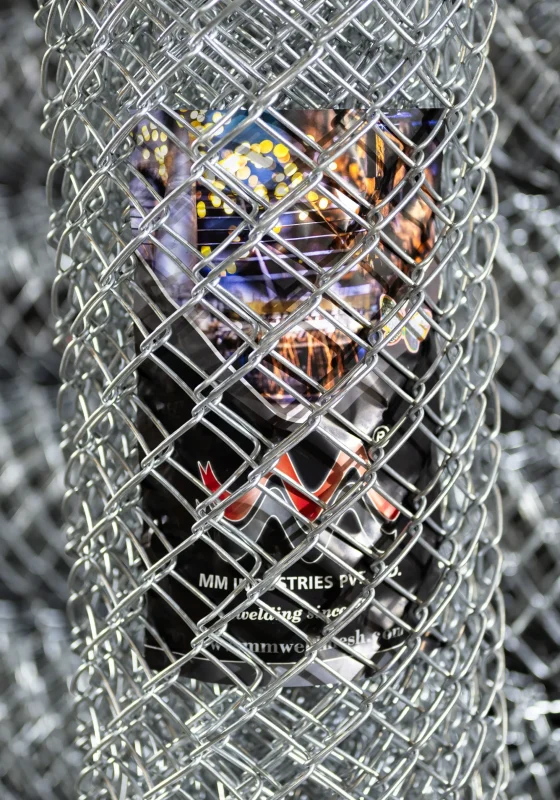
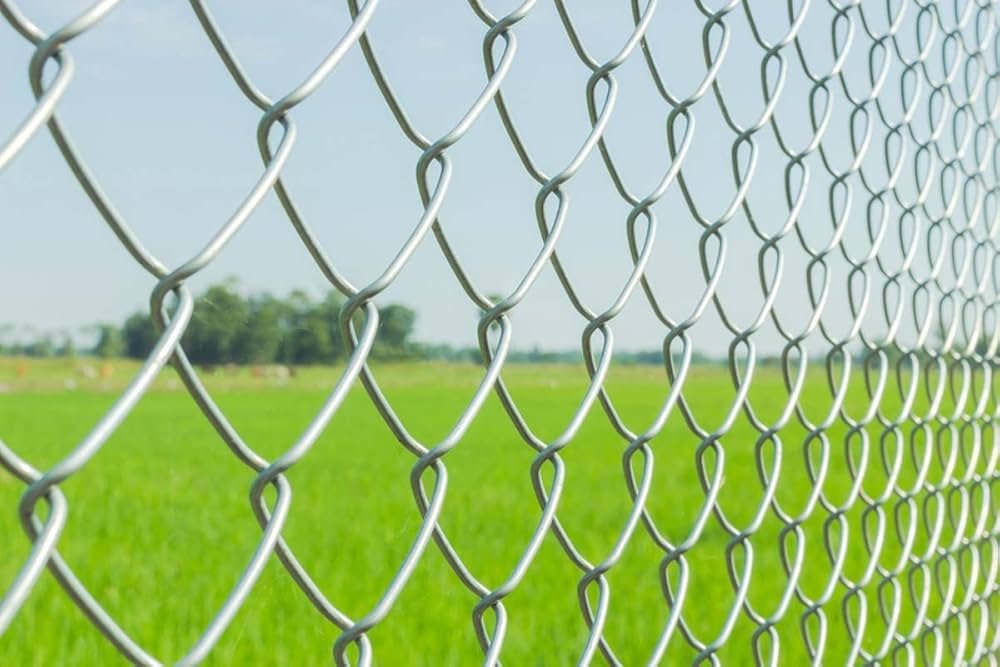
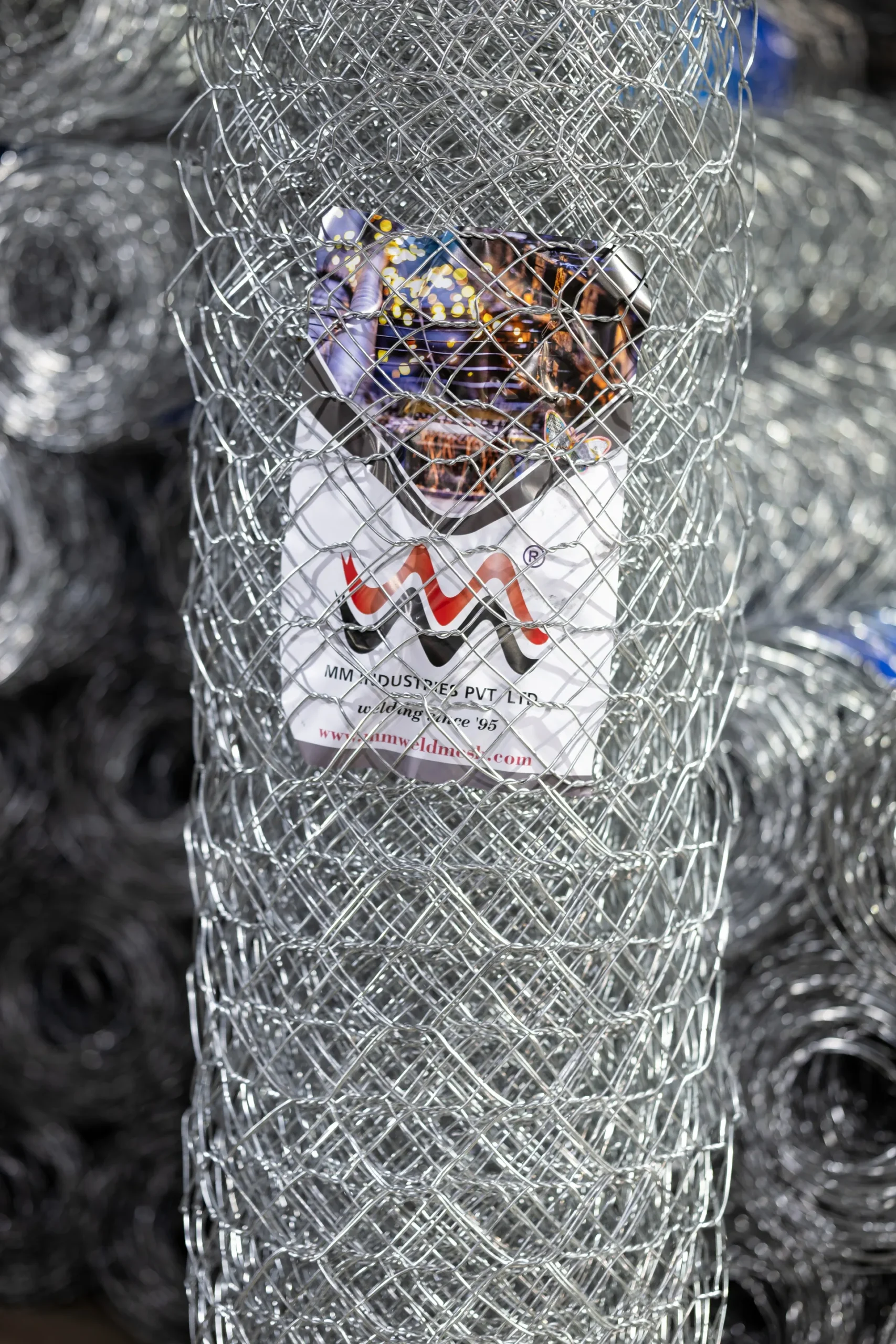
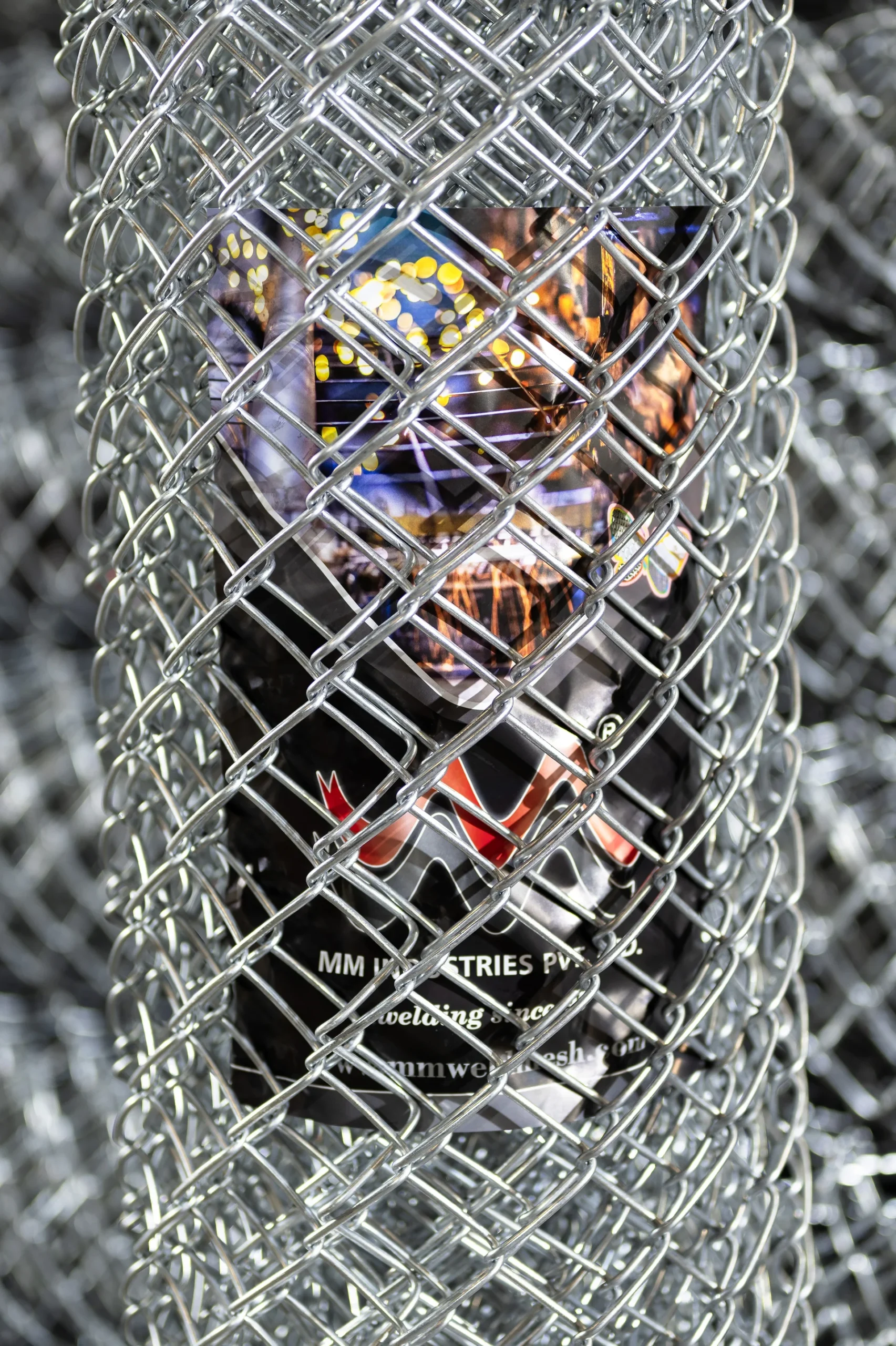
Chain link fence consists of a continuous mesh formed by weaving steel wires into a diamond pattern. Each wire is bent in a zigzag and spiraled into the adjacent wire, creating an interlocking sheet without welds or knots. The mesh is rolled, transported flat, and stretched between fixed posts during installation.
The mesh is made from drawn steel wire. For outdoor applications, it is protected either by hot-dip galvanization, which bonds a zinc layer to the steel, or by applying a PVC coating over galvanized wire. Bare steel is not used for permanent fencing because it corrodes quickly.
In India the product is governed by IS 2721:2003, “Galvanized Steel Chain Link Fence Fabric — Specification” (Second Revision), issued by the Bureau of Indian Standards under the Wire Ropes and Wire Products committee (MED 10). The base wire follows IS 280 (mild steel wire) and the zinc coating follows IS 4826 (hot-dip zinc-coated wire). Internationally, the equivalent specifications are ASTM A392 (zinc-coated fabric) and ASTM F668 (PVC-coated fabric).
The diamond pattern is essential to the function of chain link fencing. When a load is applied at any point, the interlocked wires distribute the force to the tension lines and posts, allowing the mesh to absorb impact rather than break. This design provides greater durability against vehicles, livestock, sports balls, and intrusion compared to rigid panels of similar weight.
Key takeaway: Chain link fence is woven, not welded. Its diamond mesh spreads load, and its zinc or PVC coating is what determines how long it survives outdoors. Specify to IS 2721 and the coating is defined, not guessed.
How chain link fence works?
A chain link line is a tensioned system rather than a series of panels. Four main components support the load:
- Posts set in concrete, spaced approximately 3 metres apart, anchor the line.
- Straining wires run along the top, bottom, and sometimes the middle, pulled tight to keep the mesh flat.
- The mesh fabric is stretched between the straining wires and secured.
- Struts and stays are installed at corners and ends, where tension is highest.
The flexible mesh absorbs impact and returns to its original shape. Whether struck by a cricket ball, pressed by an animal, or tested by a person, the surface yields slightly and rebounds, unlike brittle materials that crack. This flexibility makes chain link the preferred choice for sports enclosures and livestock fencing.
The open diamond pattern provides near-total visibility, which is important for security. Guards and cameras can see through the fence, preventing concealment. The design also allows wind to pass through, reducing stress on the posts during storms. This is especially beneficial in the high-wind regions of central India.
Service life depends on the coating and environmental conditions. A properly galvanised line in a dry inland climate lasts 15 to 20 years. Adding a PVC coating or installing the fence in coastal or industrial areas changes these figures, as detailed in the coating section below covers in details.
Types of chain link fence
Chain link is classified by coating, wire gauge (duty rating), and selvedge, which refers to the treatment of wire ends at the top and bottom of the roll. MM Industries offers all standard variants.
By coating
Galvanized (GI) chain link uses steel wire hot-dip coated in zinc. It is the standard choice for boundaries, industrial yards, agriculture, and government projects. This variant features a silver-grey finish, offers the lowest cost per metre, and provides a 15 to 20 year lifespan in inland areas.
By duty rating (wire gauge)
- Residential or light duty (2.0–2.5 mm wire, 50–63 mm mesh) is suitable for gardens, farmhouses, poultry enclosures, and dividing fences.
- Standard or commercial duty (3.0–3.55 mm wire, 50 mm mesh) is used for boundary walls, warehouses, schools, and most compound fencing. This is the most frequently ordered specification.
- Heavy duty / industrial (4.0 mm wire, 40–50 mm mesh). Factories, substations, solar parks, high-traffic perimeters.
- High-security (4.0 mm wire, 25–40 mm mesh, often topped with concertina or barbed wire) is used for airports, defence facilities, fuel depots, and critical infrastructure. The tighter mesh resists cutting and prevents finger-holds.
By selvedge (per IS 2721)
IS 2721 defines four fabric schedules by how the wire ends are finished:
- Both ends twisted — a barbed top edge that deters climbing. Common on security and boundary lines.
- One end knuckled and one twisted provides a twisted (barbed) top and a smooth (knuckled) bottom.
- Both ends knuckled result in a smooth top and bottom, suitable for areas where safety is a priority, such as schools, sports facilities, and public spaces.
- Both ends plain — cut ends, typically for enclosed or temporary use.
Applications by industry
Chain link fencing is used in every sector requiring a boundary. MM Industries provides chain link fabric for the following applications:
Industrial and infrastructure: factory perimeters, warehouses, godowns, substations and power installations, solar parks, water treatment plants, highway and railway boundaries, airport landside fencing, and construction site enclosures.
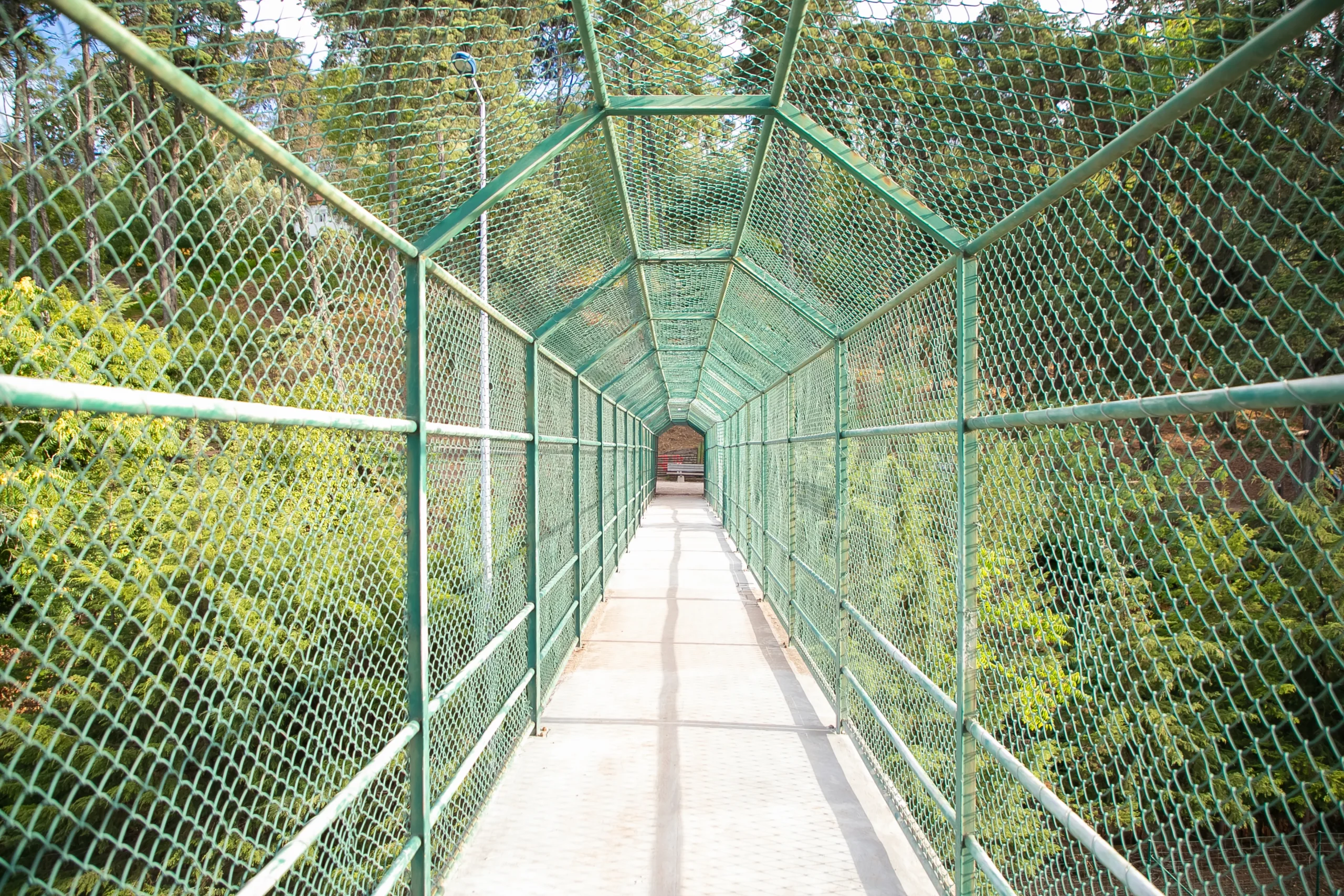
Institutional and public: school and college grounds, hospital compounds, government offices, municipal parks, and playgrounds.
Sports: cricket practice nets and boundaries, tennis and basketball courts, football grounds, and stadium enclosures. Knuckled selvedge is standard to ensure player safety.
Agriculture and rural: farmland and orchard boundaries, poultry and dairy enclosures, animal and cattle containment, plantation protection, and grain-yard fencing. This segment is a key market in Chhattisgarh, Madhya Pradesh, and Odisha.
Residential and commercial: house compounds, farmhouses, gated layouts, resorts, and commercial plots.
Chain link is preferred due to its low cost per metre and visibility. Rigid walls or welded panels are significantly more expensive, and most applications require transparency rather than concealment.
Technical specifications
| Parameter | MM Industries range |
| Governing standard | IS 2721:2003 |
| Material | Galvanized steel (GI); PVC-coated galvanized steel option |
| Base wire | Mild steel wire to IS 280 |
| Zinc coating | Hot-dip, to IS 4826 (coating mass to specification/class) |
| Wire diameter | 2.0 mm to 4.0 mm (approx. 14 SWG to 8 SWG) |
| Mesh opening (aperture) | 25 × 25 mm to 100 × 100 mm (50 mm most common) |
| Roll height | 3 ft to 6.56 ft (approx. 0.9 m to 2 m) |
| Roll length | Standard on request; commonly supplied in continuous rolls |
| Selvedge / end finish | Twisted, knuckled, or knuckled-and-twisted (IS 2721 schedules 1–4) |
| Surface finish | Bright galvanized (GI) |
| Tensile strength | To IS 280 / order specification |
| Custom sizes | Mesh, gauge, height, and colour made to order for bulk |
| Packaging | Rolled, wrapped for transit; project quantities on pallets |
| Country of origin | India (Raipur, Chhattisgarh) |
Indicative fabric weight:
| Mesh | 14swg (1.9 – 2.0mm) | 12 swg (2.5 – 2.6mm) | 10swg (3.15 – 3.25mm) | 8swg (3.9 – 4.0mm) |
| 25 x 25mm | ~2.042 kg/m² | ~3.7 kg/m² | ~4.57 kg/m² | X |
| 50 × 50 mm | X | ~1.65 kg/m² | ~2.7 kg/m² | ~4.45 kg/m² |
| 75 x 75 mm | X | ~1.25 kg/m² | ~1.85 kg/m² | ~3.08 kg/m² |
| 100 x 100mm | X | ~0.9 kg/m² | ~1.6 kg/m² | ~2.15 kg/m² |
Key takeaway: Four values determine a chain-link order — wire gauge, mesh opening, coating (GI or PVC), and height. Everything else follows from those.
Wire gauge (SWG to mm) explained
Indian buyers still specify wire by Standard Wire Gauge (SWG), while drawings and IS tables use millimetres. Confusing the two is the most common ordering error, because a lower SWG number means a thicker, stronger wire. Kindly refer this conversion:
| SWG | Diameter (mm) | Typical duty |
| 8 SWG | 3.9 – 4.0 mm | Heavy duty, factory and solar perimeters |
| 10 SWG | 3.15 – 3.25 mm | Standard commercial / boundary |
| 12 SWG | 2.5 – 2.6 mm | Light commercial / farmhouse |
| 14 SWG | 1.9 – 2.0 mm | Residential / poultry / light duty |
Key takeaway: A lower SWG indicates a thicker, stronger wire. Confirm the millimeter measurement on the datasheet and verify it upon delivery. This simple check prevents most chain link failures.
Galvanized vs PVC-coated: which you should choose
Both start as galvanized steel. The question is whether you add a polymer jacket on top.
| Factor | Galvanized (GI) | PVC-coated |
| Corrosion protection | Zinc layer; 15–20 yr inland | Zinc + polymer; longer in harsh settings |
| Best environments | Dry, inland, industrial, agricultural | Coastal, humid, chemical, high-rainfall |
| Appearance | Silver-grey metallic | Green or black, cleaner look |
| Cost per metre | Lower | Higher |
Select galvanized wire for most inland projects, such as compound walls, agricultural boundaries, industrial yards, and government works in central India. The zinc coating provides reliable protection in dry climates for up to twenty years, ensuring you only pay for the necessary level of protection.
Opt for PVC-coated wire in coastal, chemically aggressive, or high-rainfall environments, or when appearance is important, such as for school grounds, housing layouts, or resorts. The polymer coating protects the zinc from moisture and salt, and provides a finished green or black appearance instead of exposed metal.
It is important to note that the effectiveness of PVC coating depends on its bond to the wire. Inferior sprayed coatings can crack and peel, allowing moisture to become trapped and causing the wire to rust more quickly than bare galvanized wire. Always specify a fused (extruded) coating over properly galvanized core wire, rather than a painted finish. MM Industries ensures these specifications are met in-house.
Comparison Tables
Chain link vs Welded wire mesh
| Factor | Chain link | Welded wire mesh |
|---|---|---|
| Construction | Woven, flexible diamond | Welded rigid grid |
| Strength | Distributes impact; hard to breach a whole line | Rigid; higher single-panel stiffness |
| Flexibility | High — flexes and recovers | Low — panels are fixed |
| Security | Good; tighter mesh for high security | Good; rigid panels resist deformation |
| Cost per metre | Lower | Higher |
| Visibility | Excellent | Excellent |
| Installation | Rolled, stretched on site | Panel-by-panel fixing |
| Maintenance | Minimal; easy local repair | Minimal; damaged panels swapped whole |
| Best for | Long boundaries, sports, agriculture, security | Machine guards, rigid panel fencing, gabions |
See the welded wire mesh page for the rigid-panel alternative.
Chain link vs Barbed Wire
| Factor | Chain link | Barbed wire |
|---|---|---|
| Security | Full-height physical barrier | Deterrent line only |
| Appearance | Clean mesh surface | Bare strands |
| Durability | 15–20 yr galvanized | Depends on coating and tension |
| Installation | Posts + tensioned fabric | Strung strands between posts |
| Maintenance | Minimal | Re-tensioning over time |
| Cost | Higher (full barrier) | Lower (line only) |
| Safety | Knuckled option is safe to touch | Injury risk by design |
| Best for | Compound and perimeter barriers | Cattle lines, farm boundaries, fence tops |
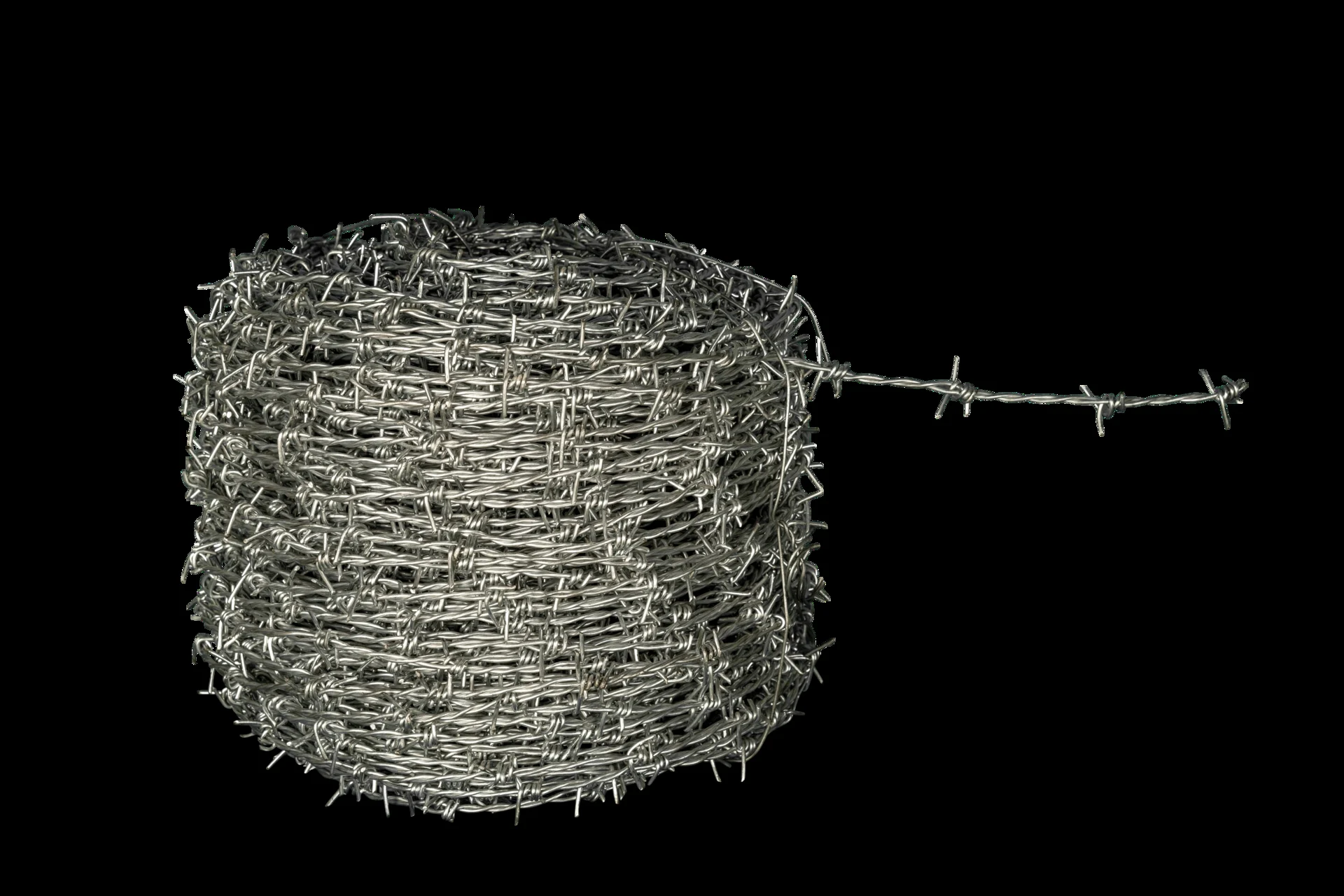
Barbed wire and chain link are often combined — a chain link line topped with barbed wire. See the barbed wire page.
Chain link vs Knotted mesh (Rama Jali)
| Factor | Chain link | Knotted mesh (Rama Jali) |
|---|---|---|
| Agricultural use | Boundaries, poultry, enclosures | Field, orchard, and grassland fencing |
| Livestock containment | Good | Purpose-built for it |
| Flexibility | High | High, with fixed knot intersections |
| Strength | Distributes load | Knots lock the grid at each junction |
| Cost | Moderate | Application-dependent |
| Lifespan | 15–20 yr galvanized | Comparable when galvanized |
| Best for | Mixed security + boundary use | Extensive rural/livestock fencing |
For large agricultural runs, compare with Rama Jali knotted mesh and Shyama Jali twisted mesh.
Chain link is the most versatile option, offering flexibility, visibility, and cost efficiency for large installations. Welded mesh provides superior rigidity, barbed wire is the most economical deterrent, and knotted mesh is best suited for livestock enclosures. Most sites use chain-link fencing, often topped with barbed wire.
Buying Guide and Procurement Checklist
By addressing these seven decisions, you can submit a clear order that manufacturers can quote and deliver efficiently, minimizing unnecessary communication.
- Wire gauge. This determines both strength and cost. Use 2.0–2.5 mm for light duty, 3..15–3.25 mm for standard, and 4.0 mm for heavy or security applications. Always specify in millimetres, not only SWG.
- Mesh opening. A 50 mm opening is standard. Select tighter openings (25–50 mm) for security or small animals, and wider openings (63–100 mm) for cost savings on low-risk boundaries.
- Coating. Use galvanized coating for dry inland locations. Choose PVC-coated (fused) options for coastal, chemical, or visually sensitive sites.
- Height. Select height based on risk: 4–6 ft for residential and agricultural use, 6–8 ft for commercial and industrial, and 8–12 ft with a top guard for security applications.
- Selvedge. Use a twisted top for deterrence and a knuckled finish for public safety areas.
- Environment. For coastal or industrial-chemical environments, select PVC coating and higher zinc content.
- Quantity and delivery. Confirm roll lengths, total running metres, and delivery timelines in advance to ensure accurate project pricing.
Common purchasing mistakes
- Relying solely on SWG when ordering may result in receiving under-gauge wire.
- Accepting “PVC-coated” wire without verifying that the coating is fused over a galvanized core can lead to quality issues.
- Failing to review the zinc-mass specification may result in quotes for the same wire size that are not truly comparable.
- Purchasing fabric without accounting for the cost of posts, straining wire, and fittings can lead to incomplete budgeting.
- Choosing mesh opening for price without checking the security requirement.
What affects the price?
Chain link pricing is based primarily on the weight of steel. Any additional steel or coating increases the overall cost.
- Wire gauge is the most significant factor. Because weight increases with the square of the diameter, 4 mm wire is substantially more expensive per metre than 2.5 mm wire.
- Mesh opening size also affects cost. Smaller openings require more wire per area, increasing weight and price.
- Coating type influences price. PVC-coated chain link is more expensive than plain galvanized, and a higher zinc mass increases cost compared to a thinner coating.
- Height and length directly affect cost. Greater fabric requirements result in higher prices.
- Steel and zinc market rates also impact pricing, as chain link costs reflect changes in commodity prices.
- Order volume affects unit pricing. Bulk or project quantities typically receive more favorable per-metre rates than smaller retail orders.
A low quote often reflects reductions in less visible factors such as wire diameter or zinc mass. Always compare quotes based on identical wire gauge and coating specifications, rather than headline price alone.
Why choose MM Industries's Chain Link Fence
MM Industries has been manufacturing wire mesh and fencing at Raipur, Chhattisgarh since 1995 — over 30 years of production for infrastructure firms, contractors, industries, dealers, and government bodies.
- All manufacturing processes- weaving and finishing- are managed in-house on a single production line. This ensures precise control over wire diameter and coating specifications, with no outsourcing.
- Our products conform to IS 2721, the governing Indian Standard, which is essential for tenders and government projects.
- We have the capacity to produce and dispatch bulk project quantities on schedule.
- We offer customization of mesh, gauge, height, selvedge, and PVC color to meet specific project requirements.
- We provide regular delivery across Pan-India.
- Our established dealer network enables faster regional supply.
- We offer direct technical support to help specify the right fabric for your site and budget.
MM Industries manufactures the complete range of fencing products in-house, allowing you to source chain link, welded mesh, barbed wire, and concertina coil from a single supplier for your project.
Request a quote → | Become a dealer → | Call +91 93298 07373 →
Frequently Asked Questions
Related Products
CALCULATOR
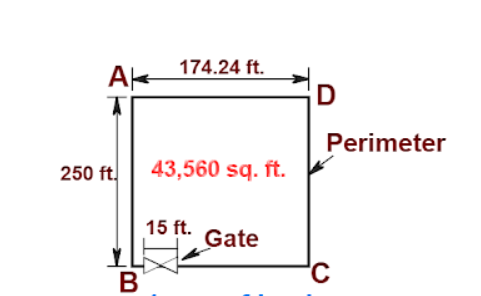
Calculators to estimate welded mesh weight and fencing boundary length based on your requirements.
BOUNDARY CALCULATOR
CALCULATE BOUNDARY LENGTH