Double Twisted Mesh (Shyama Jali) Manufacturer in India
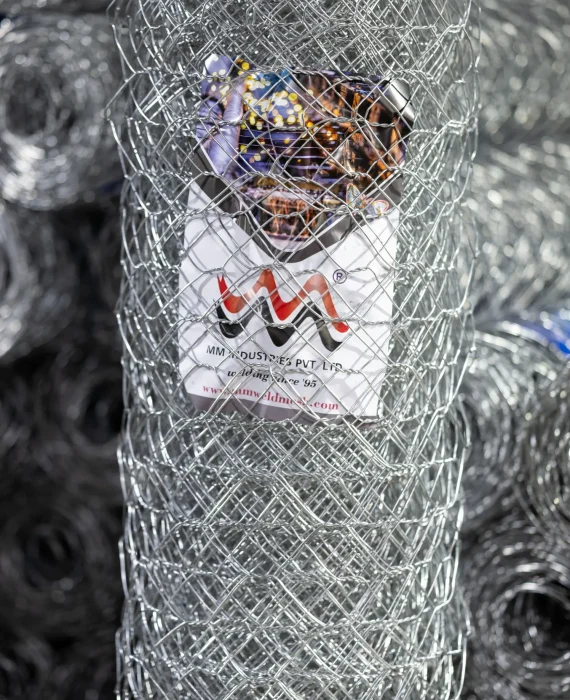
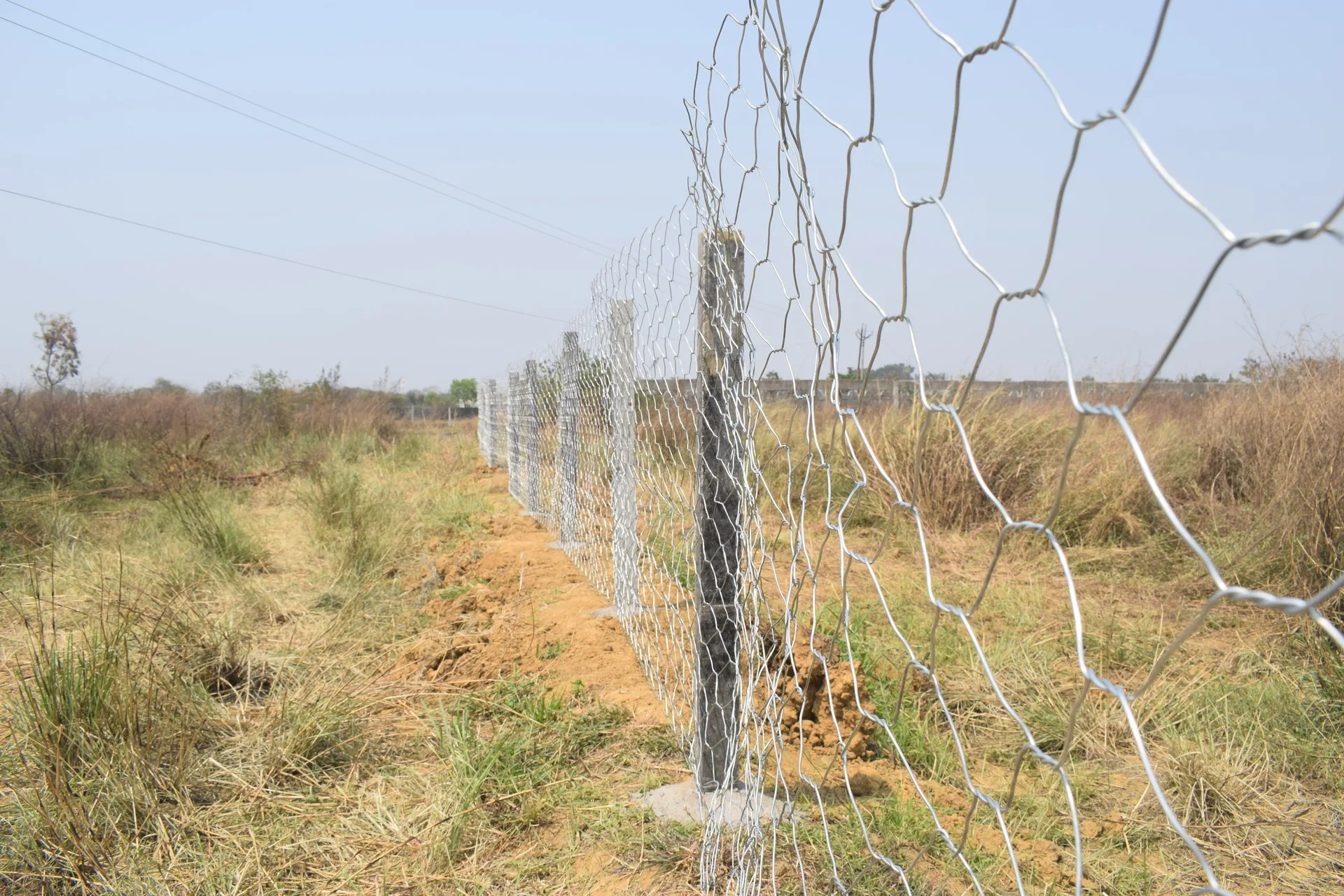
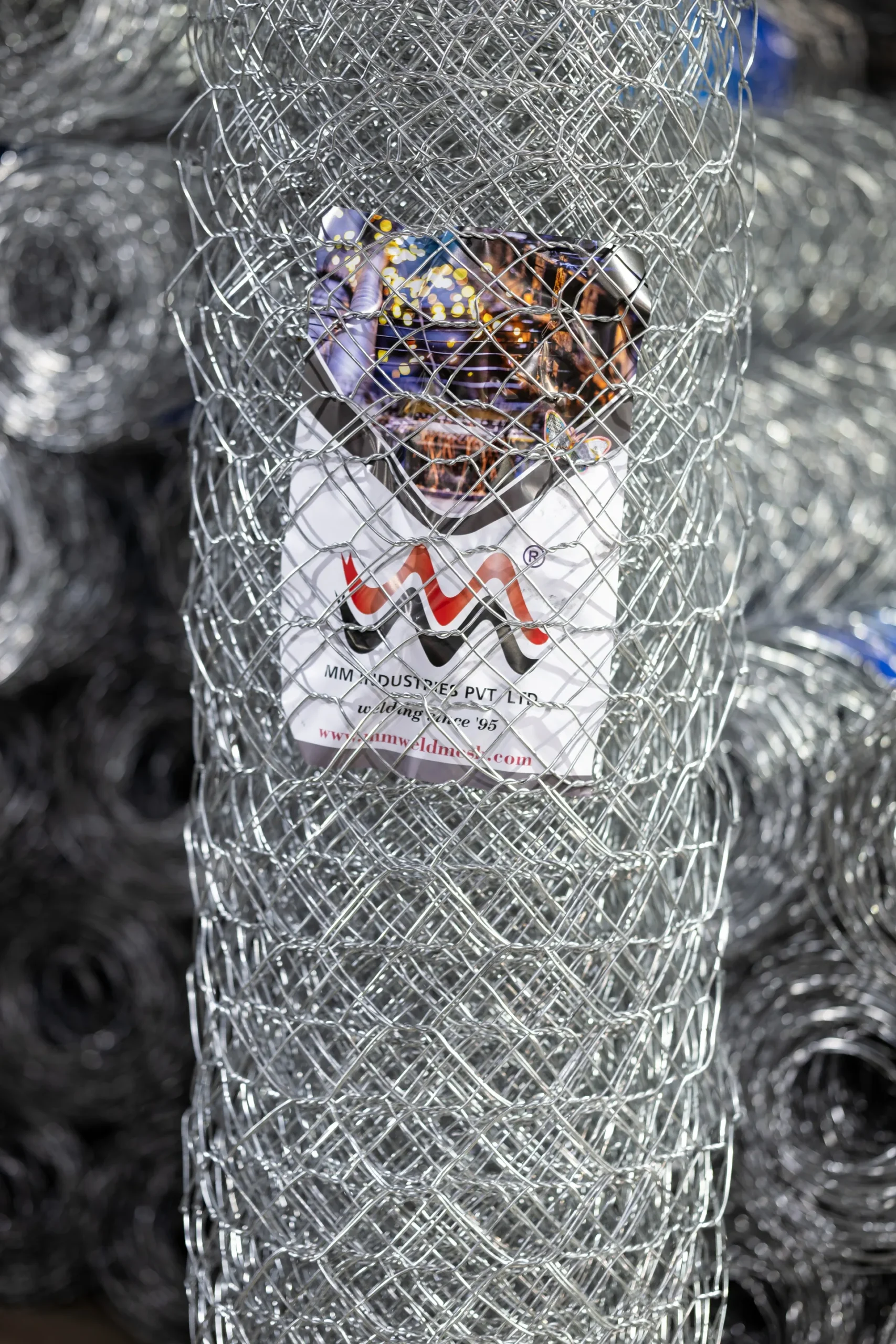
Double-twisted (Shyama Jali) mesh is a mechanically woven hexagonal steel wire fabric, where each pair of wires is twisted together through three half-turns before joining the next wire. This twist enables the mesh to deform without failing, distribute point loads over a wide area, and remain intact even if a wire is cut.
MM Industries has been manufacturing wire mesh in Raipur since 1995. We are supplying double twisted mesh with galvanized finishes to farmers, contractors, industrial buyers, and infrastructure projects throughout Chhattisgarh, Madhya Pradesh, Odisha, and across India. In the regional market, the product is known as Shyama Jali, a name we introduced to simplify ordering for customers.
The product serves a wide range of applications. Lighter variants are used for orchard fencing and poultry runs, while heavier mesh, made from 2.7 mm and 3.0 mm galvanized wire and assembled into gabion boxes and revet mattresses, is used for retaining highway embankments, protecting riverbanks from scour, and catching rockfall on hillsides. Both types are shown on this page, clearly separated, as ordering the incorrect variant is the most common and costly mistake buyers make.
Quick Facts
| Product | Double twisted hexagonal wire mesh (Shyama Jali) |
| Construction | Mechanically woven, three half-turn double twist, non-ravelling |
| Base material | Mild steel wire to IS 280 |
| Coatings | Hot-dip galvanized (GI) |
| Wire diameter range | 2.00mm – 2.20 mm |
| Mesh openings | 60×80, 80×100, 100×120 mm (engineering) · 100×100 mm nominal (fencing) |
| Roll height | Up to 1.5 m (5 ft) standard; taller to order upto 1.82 m (6 ft) |
| Roll length | 15 m and 30 m |
| Reference standard | IS 16014 · IS 280 · IS 4826 · IRC:SP:116-2018 · MoRTH Clause 2500 |
| Manufacturer | MM Industries Pvt. Ltd., Raipur, Chhattisgarh — since 1995 |
| Supply | Pan-India, bulk and customised production |
| Country of origin | India |
What Is Double Twisted Mesh?
Definition: Double twisted mesh is a hexagonal steel wire mesh produced by mechanically twisting continuous pairs of wires through three half-turns and connecting adjacent wires to form hexagonal openings. The twist locks each junction mechanically, so the fabric does not unravel when a single wire is cut. It is manufactured from galvanized steel wire, with an optional PVC or polymer overcoat, and is used for gabion structures, erosion control, slope protection and heavy-duty fencing.
Two wires are positioned side by side. The machine grips and rotates them through three half-turns before releasing them. Each wire then separates and pairs with the adjacent wire, which is twisted in turn. Repeating this process across a wide loom produces a continuous fabric of hexagonal openings, with each side formed by either a single wire or a twisted pair.
There are no welded joints in this product, which fundamentally influences its performance characteristics.
A welded joint forms a metallurgical bond at a single point. While strong and rigid, it fails completely and locally when compromised, allowing the wire to pull out and create a hole. Welding heat also removes the zinc coating at each junction, which is where corrosion typically begins in welded galvanized mesh. In contrast, a double twist is a mechanical wrap that cannot be undone by tension, as the wires are physically wound together and the zinc coating remains intact.
Double twisted mesh is non-ravelling. If a single wire is cut in the middle of a panel, the tension redistributes to the surrounding twists, and the opening remains contained. In contrast, cutting one wire in a chain link fence causes the pattern to unravel along the entire strand. This property is not a marketing claim; it is the reason double twisted mesh is specified for rockfall netting and gabions exposed to impact from boulders and debris.
Each panel is bordered by a selvedge, which is a terminal wire of larger diameter than the mesh wire. The mesh wires are mechanically wrapped around the selvedge at least two and a half times. The selvedge transfers the load from the panel to the adjoining structure. A weak or missing selvedge will cause the panel to fail at the edge before the mesh body reaches its capacity. When inspecting a delivery, always check the selvedge first.
Why Is It Called Shyama Jali?
Shyama Jali is a name MM Industries gave to this product. It is not a technical designation and it does not appear in any Indian Standard.
The decision was practical. Customers typically request products by familiar, easy-to-pronounce names rather than technical specifications. Similarly, we introduced ‘Rama Jali‘ for our knotted mesh. Assigning a short local name allows dealers to stock, describe, and reorder the product without needing a specification sheet.
Consultants, EPC contractors, and government buyers should specify the product using its technical description: mesh type, wire diameter, coating class, and standard. Dealers and farmers in Central India should refer to it as Shyama Jali.
Key Takeaways
- Woven, never welded. Three half-turns per twist.
- Cutting one wire does not unravel the fabric.
- The selvedge wire is one size larger than the mesh wire and carries the panel load.
- “Shyama Jali” is MM’s trade name for the product in the regional market.
How Double Twisted Mesh Works
The engineering case for this product rests on four behaviours.
It deforms rather than cracks. Unlike rigid concrete or masonry gravity walls, gabion walls are flexible. When the foundation settles unevenly, the mesh accommodates the deformation, allowing the structure to follow the settled profile without losing integrity. IRC:SP:116-2018 states that settlement in gabion walls is unavoidable, but gabions can adjust and tolerate significant differential settlement. In contrast, a concrete wall would crack and require repair or replacement.
It absorbs energy instead of resisting it rigidly. When a boulder strikes a rockfall net or a flood-borne log hits a revet mattress, the mesh stretches and the twists tighten, dissipating impact energy over a large area and longer duration. Rigid systems, by contrast, concentrate the impact into a much higher peak force at a single point.
It distributes load through its hexagonal geometry. A hexagonal opening lacks long unrestrained spans, so a point load is shared in six directions rather than two. The punch test is a mandatory acceptance test for civil-grade mesh; it measures this behavior by driving a 350 mm circular ram into a clamped panel and recording the load at first rupture.
It is directional, which is important. Double twisted mesh is significantly stronger parallel to the twist axis than perpendicular to it, with roughly twice the strength. In a 100 mm (10×12) mesh woven from 2.7 mm galvanized wire, the tensile strength parallel to the twist is about 32.0 kN/m, compared to about 15.4 kN/m perpendicular to it.
The practical implication is to orient the twist axis along the direction of principal tension. For a gabion retaining wall, the twist should run horizontally along the wall face. For a revet mattress on a river bank, it should run along the direction of flow. Incorrect orientation can halve the structure’s capacity, even if the material meets specifications. This is a common design and supervision error, not a material failure.
Corrosion protection is a system, not just a coating. The mesh wire, selvedge wire, lacing wire, stiffener wires, and fasteners must all have the same class of protection. If a gabion is assembled with properly galvanized mesh but under-galvanized lacing wire, it will fail at the lacing and the entire structure will unzip. IRC:SP:116 lists improper galvanization of “mesh, fastening, lacing, stiffening” wires as a documented cause of gabion wall failure. Specify the coating for each component and verify each one upon delivery.
Key Takeaways
- Flexible, so it tolerates differential settlement that would crack a rigid wall.
- Absorbs impact energy rather than resisting it at a single point.
- Roughly twice as strong parallel to the twist as perpendicular — orient it correctly.
- Coating class must be identical across mesh, selvedge, lacing, stiffeners and fasteners.
Which Grade Do You Need?
Most ordering errors on this product happen here. Use this table before you ask for a price.
| Question | Fencing grade (Shyama Jali) | Civil engineering grade |
| What are you building? | Boundary, enclosure, guard, barrier | Gabion wall, revet mattress, rockfall net, soil reinforcement |
| Does it retain soil or resist water? | No | Yes |
| Is it in a BOQ or on a drawing? | Usually not | Almost always |
| Design life required? | 8–15 years typical | 25 to 120 years, specified |
| Wire diameter | 2.0–2.5 mm (12–14 SWG) | 2.20 / 2.70 / 3.00 mm |
| Selvedge | Standard edge | Terminal wire one size larger, wrapped ≥2.5 turns |
| Test certificates needed? | Coating mass, wire diameter | Mesh panel tensile, punch, pull-apart, coating mass, salt spray |
| Standard to specify | IS 280 wire, IS 4826 coating | IS 16014, with IRC:SP:116 for design |
| Sold as | Rolls, by height × length | m² of mesh, or assembled boxes by m³ |
If the answer to “does it retain soil or resist water” is yes, you need civil engineering grade. Fencing-grade mesh in a gabion will deform, bulge and eventually burst under fill pressure, and no amount of careful installation will prevent it.
Types of Double Twisted Mesh
Galvanized Double Twisted Mesh (GI)
Hot-dip galvanized steel wire is woven after coating to ensure the zinc layer remains intact at every twist. This standard product is suitable for most Indian applications.
Recommended for agricultural and industrial fencing, animal enclosures, gabion structures in dry inland areas, and temporary or replaceable works.
Estimated design life is approximately 25 years in low-aggression rural environments and about 10 years in medium-aggression urban or lightly chloride-affected areas.
Zn-Al Alloy Coated (Galfan) Double Twisted Mesh
A zinc-aluminium alloy replaces pure zinc, with options of 95% Zn / 5% Al or 90% Zn / 10% Al. This provides significantly improved corrosion resistance for the same coating mass. According to ISO 9227 neutral salt spray testing, pure zinc mesh must withstand 500 hours without more than 5% dark brown rust, Zn95/Al5 must withstand 1000 hours, and Zn90/Al10 must withstand 2000 hours.
Recommended for long-life infrastructure projects where the required design life exceeds the capabilities of zinc alone and where PVC is not preferred.
Availability: Please confirm whether MM manufactures Zn-Al coated mesh or sources the wire.
Heavy Duty Double Twisted Mesh
This mesh uses 3.00 mm wire with a 3.90 mm selvedge and is available in 80×100 mm or 100×120 mm openings. It offers higher panel tensile strength and punch resistance, making it suitable for gabion walls over 4 meters, high-velocity river training works, and rockfall protection.
Standard Double Twisted Mesh
This specification features 2.70 mm mesh wire with a 3.40 mm selvedge. It is the standard choice for gabion boxes and for most retaining and erosion-control applications.
Technical Specifications
Fencing grade (Shyama Jali as currently supplied)
| Parameter | Specification |
| Mesh opening | 100 mm x 100 mm |
| Wire diameter | 2.2 – 2.3 mm (approx. 13 SWG) |
| Wire material | Mild steel to IS 280 |
| Coating | Hot-dip galvanized |
| Zinc coating mass | 40-60 g/m² |
| Roll height | Up to 1.5 m (5 ft) |
| Roll length | 15m and 30m |
| Edge finish | Selvedged |
| Packing | Rolls |
| Typical use | Farm boundary, animal enclosure, orchard guard, industrial barrier |
Civil engineering grade (reference specification to IS 16014)
Mesh Types and Openings
| Mesh type | Nominal opening D (mm) | Tolerance |
| 6×8 | 60 | 0 to +8% |
| 8×10 | 80 | 0 to +12% |
| 10×12 | 100 | −4% to +12% |
Standards and Compliance
| Standard | What it governs |
| IS 16014 | The product standard. Mechanically woven, double-twisted hexagonal wire mesh gabions, revet mattresses, rockfall netting and other civil engineering products, in galvanized steel wire or galvanized steel wire with polymer coating. Defines mesh types, dimensions, coating classes, and the acceptance tests. |
| IS 280 | Mild steel wire for general engineering purposes. The base wire specification. |
| IS 4454 (Part 1 / Part 4) | Cold drawn unalloyed steel wire / stainless steel wire, where used. |
| IS 4826 | Hot-dip galvanized coatings on round steel wires. Governs coating mass. |
| IS 12753 | Fastener and connection materials. |
| IRC:SP:116-2018 | Indian Roads Congress guidelines for design and installation of gabion structures. The design code for highway and bridge applications. |
| MoRTH Specifications, Clause 2500 | Ministry of Road Transport & Highways specification clause under which gabion and revet mattress items are tendered. |
| EN 10223-3 / EN 10244-2 | European equivalents for hexagonal mesh and non-ferrous wire coatings, commonly cross-referenced in export and donor-funded specifications. |
| ASTM A975 | American equivalent, cross-referenced in some private-sector specifications. |
Recommended acceptance tests for buyers
Under the BIS certification scheme for IS 16014, a licensed manufacturer runs the following on each control unit: wire tensile strength, mesh panel strength, zinc or zinc-alloy coating mass, dimensional checks, workmanship inspection on each reel, punch test, and polymer coating thickness. Polymer salt-spray resistance is tested every seventh control unit, plus quarterly and annual third-party verification.
Ask for the test certificate and confirm which control unit it covers. If a supplier provides a coating mass value but cannot supply a mesh panel tensile figure, they are likely offering fencing mesh that meets only civil specifications.
Applications
Civil engineering and infrastructure
Gabion boxes and gravity retaining walls are rock-filled cages assembled into a mass gravity structure. Their free-draining design prevents pore water pressure from developing behind the wall, eliminating the need for a weep hole system. These structures are commonly used behind bridge abutments, along highway cuttings, and to retain hill roads.
Revet mattresses are shallow, large-area structures placed on river beds and banks to prevent scour. They are woven from 6×8 mesh using 2.20 mm wire. A 0.17 m mattress withstands critical velocities of approximately 3.5 m/s, a 0.30 m mattress holds up to 4.2–5.0 m/s, and a 0.5 m gabion layer resists velocities of 5.8–6.4 m/s.
Riverbank protection and river training involve the use of bank revetments, launching aprons, spurs, and guide bunds. The launching apron is specifically designed to roll down the scour slope and provide armoring as scour develops, a feature not achievable with rigid revetments.
Canal lining and channel works utilize permeable linings that resist tractive shear while allowing groundwater to equalize across the lining.
For highway embankments and reinforced soil, gabion facia units with integrated reinforcing tails are used as the facing for reinforced soil walls and slopes. These are often combined with geogrid as the primary reinforcement.
Railway formation protection includes cutting and embankment protection along rail alignments.
Rockfall protection involves draped or anchored netting on rock faces to catch and control detached blocks. In these applications, the non-ravelling property is essential.
Slope stabilisation includes surface erosion control on geotechnically stable slopes, often combined with hydroseeding to allow vegetation to root through the mesh.
In mining, applications include haul road embankments, spoil heap containment, settling pond bunds, and surface protection on overburden dumps.
Flood control measures include emergency and permanent bunds, breach closures, and toe protection for embankments.
In coastal engineering, shore protection and revetment are always constructed with PVC over Zn-Al coating.
Fencing, agriculture and industry
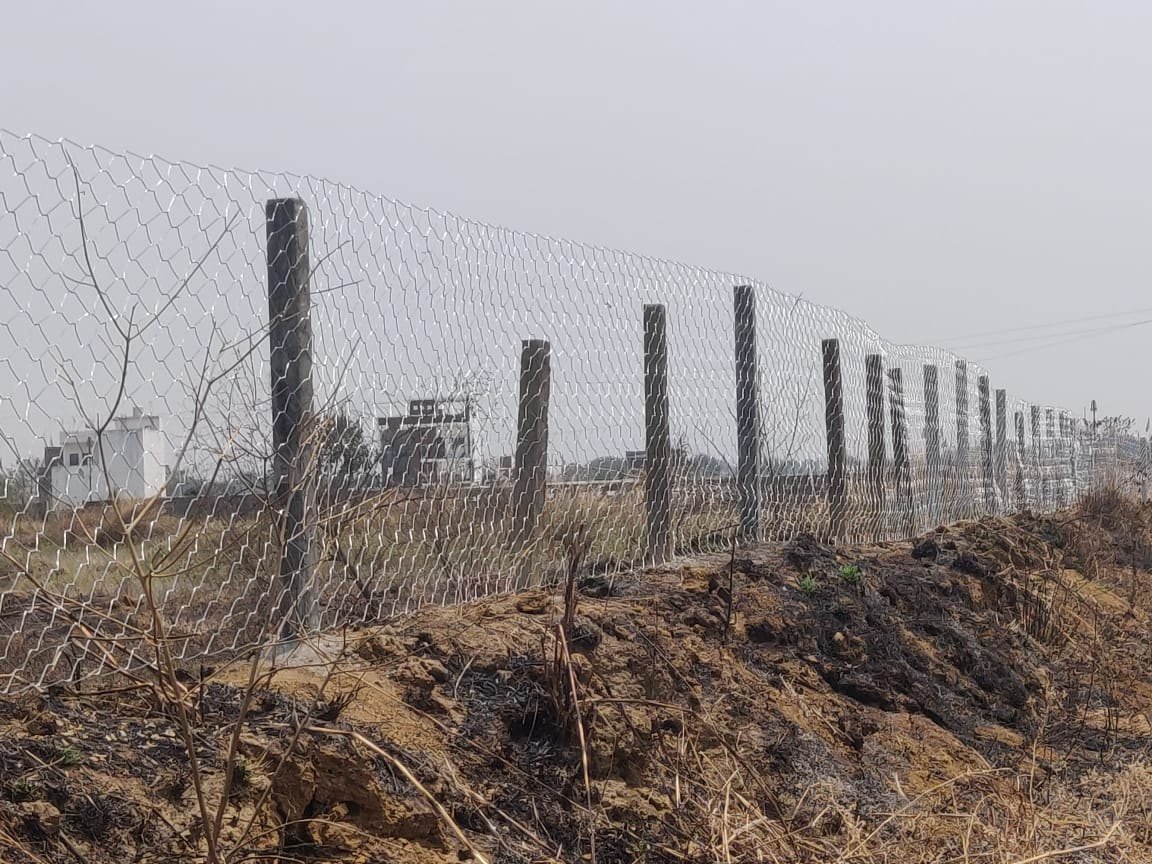
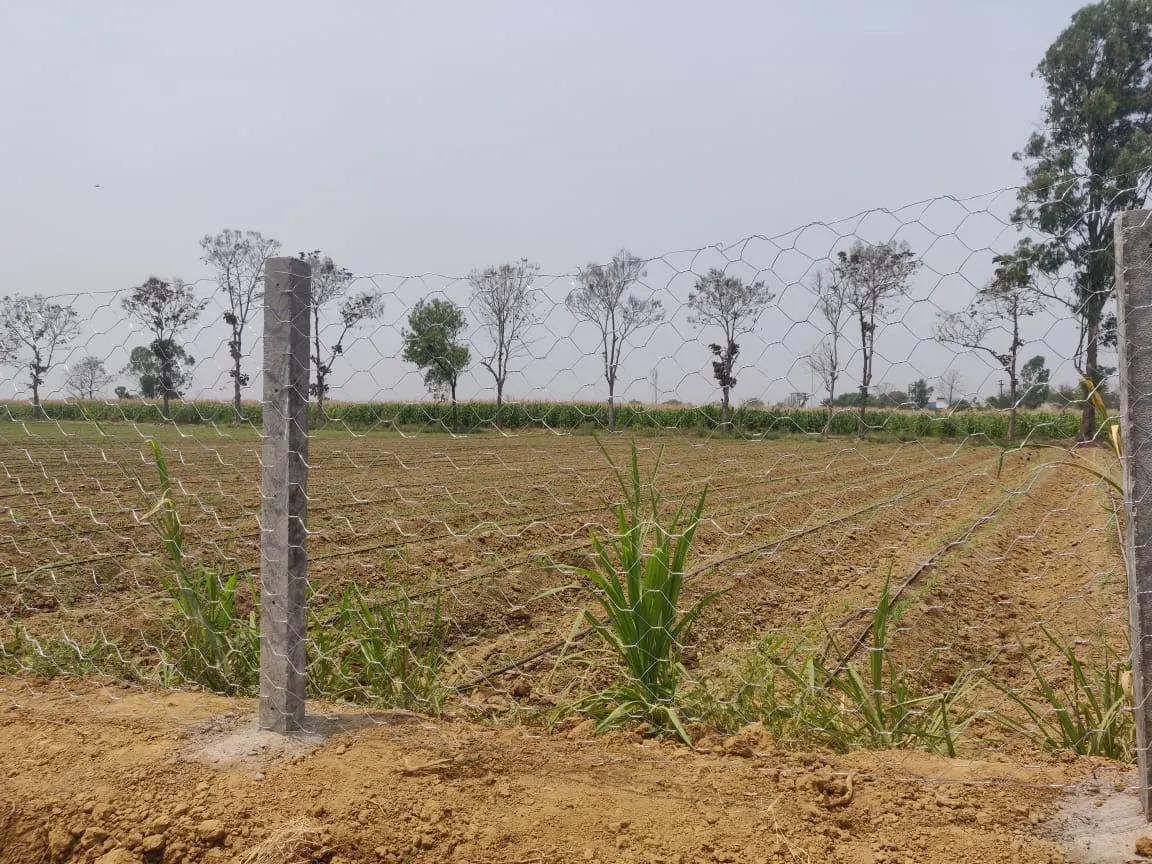
Agricultural boundary fencing is ideal for farm and orchard perimeters, especially on uneven ground. The mesh adapts to the terrain without gaps, unlike welded panels, which require stepping.
For animal enclosures, this mesh is effective for containing cattle, goats, and poultry. Its hexagonal openings resist pushing and rubbing more effectively than diamond mesh of the same wire gauge.
In industrial settings, the mesh serves as barriers and guards for machine protection, storage yard separation, and general plant boundaries.
For landscaping, it is suitable for decorative gabion planters, seating walls, garden retaining structures, and boundary features.
Features and Engineering Benefits
| Feature | What it delivers |
| Three half-turn double twist | Mechanically locked junction that cannot unwind under tension |
| Non-ravelling fabric | A cut or damaged wire does not propagate; local damage stays local |
| No welds | No heat-affected zone, no zinc burn-off at junctions, no brittle failure points |
| Hexagonal geometry | Load shared into six directions from any point |
| Selvedge wire one size larger | Panel load transferred safely into adjoining panels and structure |
| Hot-dip galvanized, woven after coating | Unbroken zinc layer through every twist |
| Optional PVC or Zn-Al coating | Design life extended to 50–120 years in aggressive environments |
| Flexible fabric | Accommodates differential settlement without cracking |
| Free-draining when filled | No pore pressure build-up behind retaining structures |
| Custom widths, heights and openings | Manufactured to drawing rather than cut down from stock |
Lifecycle Cost. The relevant comparison extends beyond price per square metre. A gabion wall is less expensive to construct than a reinforced concrete wall of equivalent height, requires no drainage system, formwork, or curing, can be assembled by local labor using hand tools, and accommodates settlement that would necessitate repairs in a concrete wall. Over a 25-year period, the cost disparity increases further.
Environmental Performance. Rock-filled gabion structures permit vegetation to establish roots through the fill, which, under most Indian conditions, colonizes the face within two or three monsoon seasons. The structure subsequently functions in part as a vegetated slope. The carbon footprint is significantly lower than that of an equivalent concrete solution, and at the end of its service life, the rock and steel components can be separated and recovered.
Double Twisted Mesh vs Other Meshes
Double Twisted Mesh vs Welded Wire Mesh
| Double Twisted Mesh | Welded Wire Mesh | |
| Construction | Woven, three half-turn twist | Resistance-welded at every intersection |
| Opening shape | Hexagonal | Square or rectangular |
| Rigidity | Flexible fabric | Rigid panel |
| If one wire is cut | Damage stays local | Panel opens at the cut |
| Differential settlement | Absorbs it | Panel distorts or joints fail |
| Impact resistance | High; absorbs energy by deformation | Lower; brittle at welds |
| Corrosion at junctions | None, zinc unbroken | Zinc burnt off at welds unless galvanized after welding |
| Appearance and rigidity of face | Requires formwork to keep face true | Naturally straight, sharp face |
| Cost | Lower per m² for equivalent duty | Higher |
| Typical life (GI, inland) | 20–25 years | 15–20 years, less if welded then galvanized |
| Best for | Gabions, erosion control, rockfall, uneven terrain | Architectural gabions, straight-faced walls, panel fencing |
If a straight architectural face is the priority, welded gabions win. If the ground will move, or the structure will be struck, double twisted wins. See our Welded Wire Mesh page.
Double Twisted Mesh vs Chain Link Fence
| Double Twisted Mesh | Chain Link Fence | |
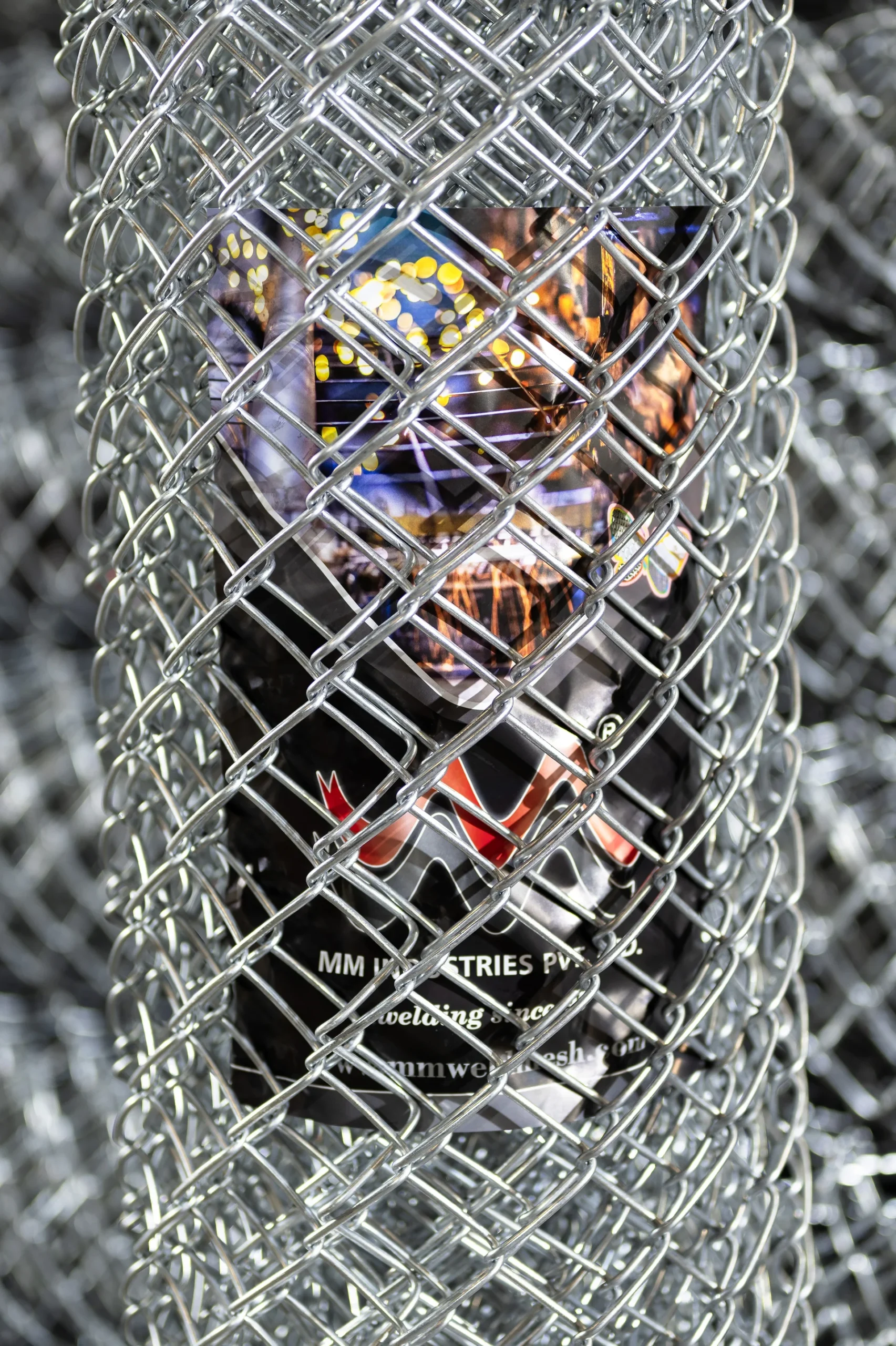
| Construction | Woven and twisted | Helically interwoven diamond pattern |
| If one wire is cut | Damage stays local | Unzips along the full strand |
| Can it retain fill? | Yes, in gabion form | No |
| Tension required | Modest | Requires tensioning and straining posts |
| Terrain following | Excellent | Good |
| Security value | Moderate | Moderate; both are cut-through |
| Cost per running metre | Comparable | Comparable |
| Best for | Gabions, erosion control, animal enclosure, uneven ground | Boundary and security fencing on prepared lines |
See our Chain Link Fence page.
Double Twisted Mesh vs Knotted Mesh (Rama Jali)
| Double Twisted Mesh | Knotted Mesh (Rama Jali) |
| Construction | Twisted wire pairs, hexagonal | Vertical and horizontal wires joined by a fixed knot, rectangular |
| Opening | Uniform hexagonal | Graduated — smaller at the bottom, larger at the top |
| Can it retain fill? | Yes | No |
| Livestock containment | Good | Excellent; graduated opening suits mixed stock |
| Structural / geotechnical use | Yes | No |
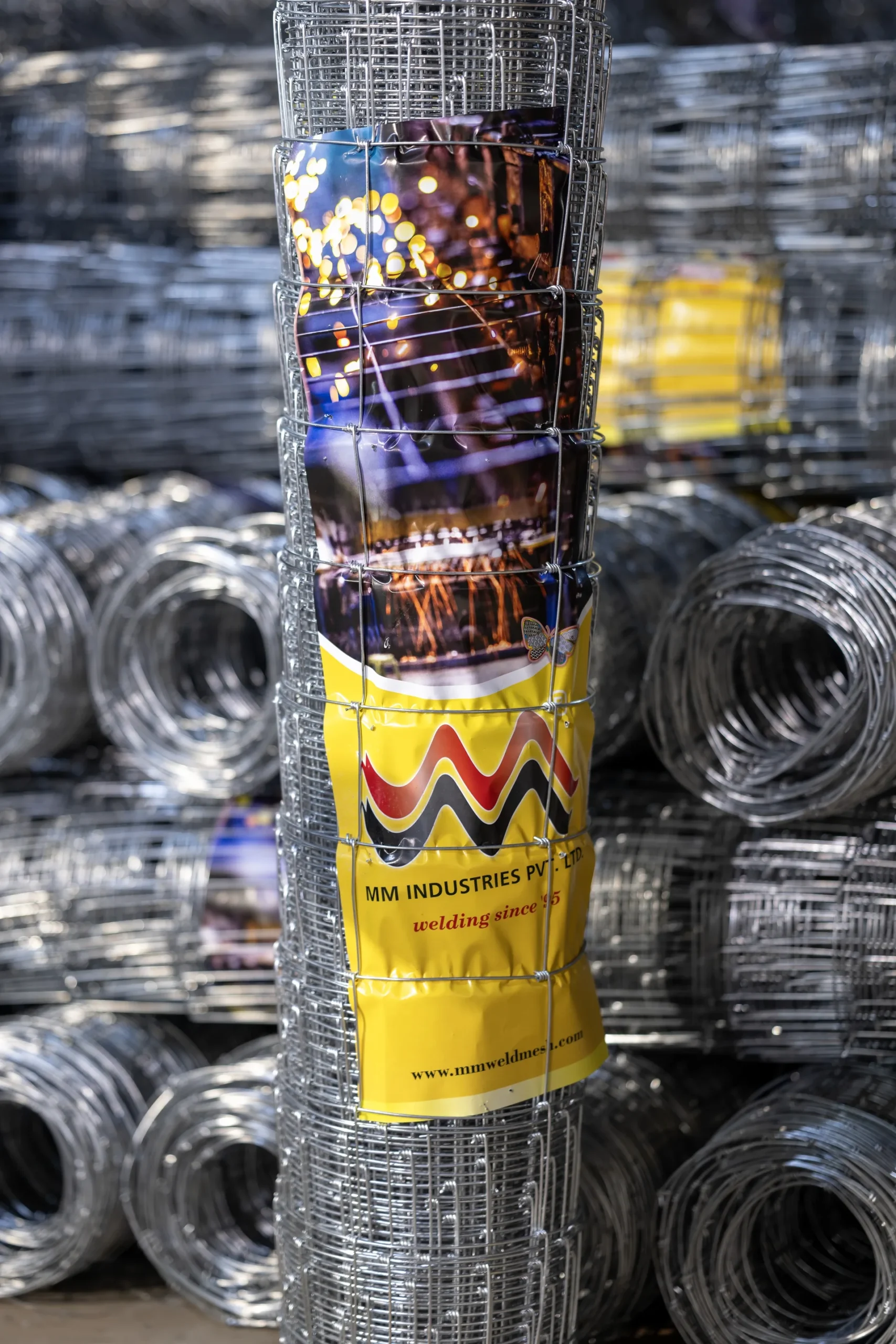
| Wire gauges | 13 swg & 14 swg | 12 and 13 SWG |
| Best for | Gabions, slope protection, heavy fencing | Grassland, livestock, farm perimeter |
See our Knotted Mesh (Rama Jali) page.
What can affect the price?
Double-twisted mesh is quoted per kilogram, per square metre, or per cubic metre of assembled gabion, depending on the product. The variables that move the number:
- Steel price. Wire rod is the largest input, and it moves with the market. Quotes are typically valid for 24 hours.
- Wire diameter. Weight per m² rises with the square of the diameter. Moving from 2.70 mm to 3.00 mm increases the steel content by roughly 23%.
- Mesh opening. Smaller openings mean more wire per m². A 6×8 mesh is heavier per m² than a 10×12 at the same wire diameter.
- Zinc coating mass. The single most commonly cut corner in this product. Zinc is expensive, and the difference between a compliant and non-compliant coating is invisible without a test.
- Coating type. PVC over GI and Zn-Al alloy both cost materially more than plain zinc and are worth it in the environments that need them.
- Assembly. Flat mesh rolls cost less than factory-assembled gabion boxes with diaphragms.
- Order volume. Bulk manufacturing runs price better than stock draws.
- Customisation. Non-standard widths, heights and openings require loom changeover.
- Freight. Raipur to site. Gabion material is bulky relative to its value, so distance matters.
- Testing and certification. Third-party test certificates per consignment carry a cost.
We do not publish rate cards, because a rate without a mesh type, wire diameter and coating class is not a price. Send us the specification, or the BOQ line, and we will quote against it.
Why Choose MM Industries
Established in 1995, we have over 30 years of experience producing wire mesh and fencing at our Raipur, Chhattisgarh facility. As a manufacturer, not a trader, we handle weaving in-house.
Located in Central India, Raipur is near the mineral belt and the infrastructure corridor spanning Chhattisgarh, Madhya Pradesh, and Odisha. For regional projects, freight from Raipur is more cost-effective and offers shorter lead times compared to Ahmedabad or Delhi.
Bulk production capacity. Sustained volume for project-scale requirements rather than dealer-lot quantities.
We are ISO 9001:2015 certified and conduct in-house testing of wire diameter, coating mass, and mesh dimensions for every production run. Third-party test certificates are available upon request.
Our engineering team reviews your BOQ or drawings and provides honest feedback on whether the specifications are suitable for your application, including recommendations for more cost-effective alternatives when appropriate.
We offer direct project supply nationwide and maintain a dealer network throughout Central India. We welcome dealership enquiries.
Frequently Asked Questions
CALCULATOR
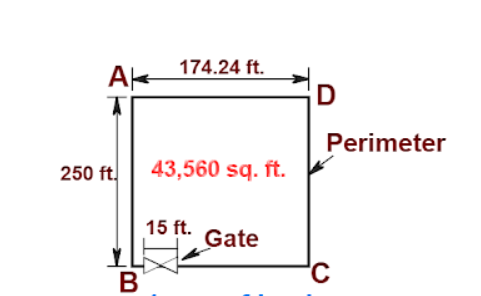
Calculators to estimate welded mesh weight and fencing boundary length based on your requirements.
BOUNDARY CALCULATOR
CALCULATE BOUNDARY LENGTH