

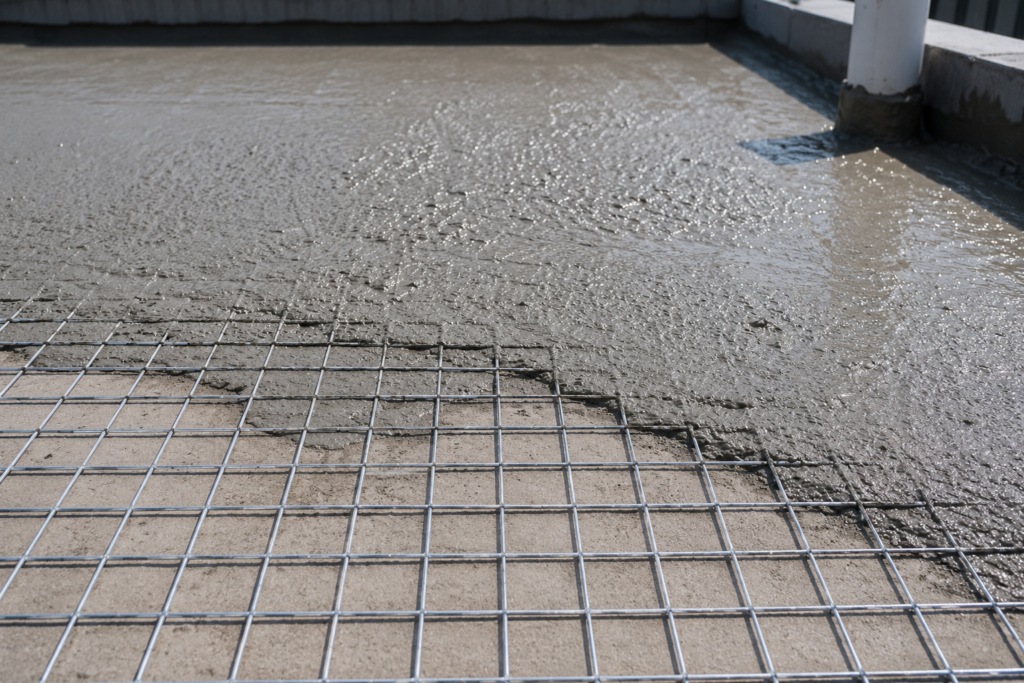
Water doesn’t fail a roof in one dramatic moment. It finds a hairline crack, sits there through a monsoon, and works its way through concrete over months. By the time a stain shows up on the ceiling below, the membrane has usually been compromised for a while. This is why the reinforcement layer inside a waterproofing system matters as much as the membrane itself — and why GI welded mesh has become the standard choice for contractors, architects, and builders who need a waterproofing system that survives real-world stress, not just a lab test.
This guide covers what GI welded mesh actually does inside a waterproofing membrane, how it compares to fiberglass and other reinforcement options, the specifications that matter when you’re sourcing it, and where it fits into a practical application sequence.
What Is GI Welded Mesh?
GI welded mesh — galvanized iron welded wire mesh — is a rigid grid formed by resistance-welding steel wires at every intersection, then hot-dip galvanizing the finished mesh (or galvanizing the wire before welding, depending on the manufacturing route) to give it a zinc coating for corrosion resistance. The welded structure, as opposed to a woven or twisted one, means the mesh holds its shape and spacing under load rather than distorting.
In waterproofing applications, this mesh is embedded between coats of a cementitious, polymer-modified, or elastomeric waterproofing system. It doesn’t replace the membrane’s water-blocking chemistry. It reinforces it structurally, giving the coating tensile strength and crack-bridging capacity that the coating alone cannot provide.
Why Waterproofing Membranes Need Mesh Reinforcement at All
A waterproofing membrane’s job is to stay intact and continuous. The moment it develops a crack, split, or pinhole, water finds a path through. Most membrane failures aren’t chemical failures — the coating itself is often still capable of resisting water — they’re mechanical failures caused by:
- Substrate movement. Concrete slabs expand and contract with temperature. RCC-to-masonry junctions, construction joints, and areas around pipe penetrations move differently than the surrounding slab.
- Thermal cycling. Terraces and exposed roofs in Indian climates go through wide daily temperature swings, especially through summer months, which stresses any rigid coating applied directly over concrete.
- Structural micro-cracking. Shrinkage cracks in the underlying slab, especially in structures more than 8–10 years old, telegraph straight through an unreinforced membrane.
- Foot traffic and mechanical load. Terraces used for storage, drying, or movement put point loads on the coating that a mesh-reinforced system distributes rather than concentrates.
A membrane with no reinforcement is only as strong as its own tensile capacity, which for most cementitious and acrylic coatings is limited. Embedding a mesh converts the membrane from a coating into a composite — the mesh carries tensile load, the coating carries the waterproofing chemistry, and together they resist cracking far better than either does alone.
How GI Welded Mesh Reinforces a Waterproofing System
The mechanism is straightforward but worth understanding, because it explains why mesh selection matters:
1. Crack bridging. When a substrate crack opens beneath the membrane, an unreinforced coating simply tears along the same line. A mesh embedded in the coating spans the crack, distributing the stress across multiple wire intersections instead of concentrating it at one point. This is the single biggest reason mesh-reinforced systems outlast unreinforced ones on older or crack-prone terraces.
2. Tensile strength addition. Cementitious and polymer-modified coatings have decent compressive strength but comparatively low tensile strength. Welded steel wire has high tensile strength by comparison, and a welded grid — where every intersection is a fixed weld point rather than a woven crossing — transfers load more predictably along both the longitudinal and transverse wires than a woven or expanded alternative.
3. Load distribution across the surface. Rather than one small area absorbing a mechanical shock (a dropped tool, a chair leg, a stored water tank), the rigid grid spreads that load across a wider area of the membrane, reducing the chance of localized puncture.
4. Dimensional stability during application. Because welded mesh doesn’t stretch or shift the way a woven fabric can while wet coating is being applied, it holds its position and spacing through the layering process, which keeps reinforcement uniform across the treated area — something that matters more than it sounds like on a large terrace being coated by a small crew.
GI Welded Mesh vs. Other Reinforcement Options
Mesh reinforcement is not a one-size-fits-all decision. Contractors and specifiers typically choose between a few materials, and each has a genuine use case.
| Reinforcement Type | Tensile Strength | Flexibility | Best Suited For |
|---|---|---|---|
| GI Welded Mesh | High | Low–moderate (rigid grid) | High-movement joints, older slabs, heavy foot traffic, structural crack zones |
| Fiberglass Mesh | Moderate | High | General terrace coatings, corner reinforcement, lighter-duty residential work |
| Expanded (Diamond) Mesh | Moderate–high | Higher crimp/flatness | Curved surfaces, applications needing better elongation before failure |
| Chicken (Hexagonal) Mesh | Lower | Very high | Plaster crack control at dissimilar-material joints, not primary waterproofing reinforcement |
Fiberglass mesh remains extremely common for lighter residential terrace work, largely because it’s cheap, easy to handle, and adequate for surfaces with minimal structural movement. But where a membrane needs to resist real mechanical stress — old RCC roofs with existing micro-cracking, industrial floors, water tank linings, or terraces that double as storage or drying areas — GI welded mesh’s rigidity and tensile capacity is the more dependable choice. The trade-off is workability: a rigid welded grid is harder to conform to curved details than a woven or expanded mesh, which is why many specifications call for GI welded mesh on flat field areas and a more flexible mesh or fiberglass tape at corners, upstands, and pipe penetrations.
Technical Specifications That Matter When Sourcing GI Welded Mesh
Not all GI welded mesh is equivalent, and the specification you choose has a direct bearing on how the finished waterproofing system performs. When sourcing or specifying mesh for a waterproofing project, the following parameters should be confirmed, not assumed:
- Wire diameter (gauge). Thinner wire is easier to embed cleanly between coats but offers less tensile reinforcement; thicker wire adds strength but needs a thicker coating build-up to fully encapsulate it and avoid the wire telegraphing through the finish. For most waterproofing membrane applications, lighter-gauge mesh is used compared to structural or fencing-grade mesh, precisely because it needs to sit flush within a thin coating film rather than a thick concrete pour.
- Aperture (mesh opening) size. A smaller aperture gives finer, more uniform crack distribution but requires the coating to fully penetrate and wet out each opening — too fine an aperture with a thick or fast-setting coating can trap air pockets. A larger aperture coats more easily but bridges cracks less finely.
- Galvanization (zinc coating) quality. Since the mesh sits embedded in a wet coating and, ultimately, in a system exposed to moisture by design, coating quality is not cosmetic — it’s the difference between a mesh that lasts the life of the membrane and one that rusts, stains, and eventually weakens from within. Hot-dip galvanizing after welding is generally more corrosion-resistant than mesh made from pre-galvanized wire that is then welded, because welding can damage the zinc layer at the weld point unless it is re-treated.
- Weld quality and intersection strength. A mesh is only as strong as its weakest weld. Poor resistance-welding leaves intersections that shear apart under the exact tensile load the mesh is meant to resist, defeating the purpose of using welded (rather than woven) mesh in the first place.
- Flatness and rigidity. Mesh that arrives with excessive curl or waviness from coiling is harder to lay flat and embed evenly, leading to inconsistent coating thickness across the treated surface.
In India, welded steel wire fabric for general (non-concrete-reinforcement) use is covered under IS 4948:2002, while wire fabric intended specifically for concrete reinforcement falls under IS 1566. Waterproofing-grade mesh generally sits closer to the general-use specification family, though most manufacturers supply it to project-specific gauge and aperture requirements rather than a single universal standard, since waterproofing applications vary so widely by substrate and exposure condition. When specifying mesh for a project, always confirm gauge, aperture, and galvanization thickness against the coating manufacturer’s system requirements — a mismatch between mesh selection and coating type is one of the more common causes of premature membrane failure on-site.
Where GI Welded Mesh Is Used in Waterproofing Applications
Terrace and flat roof waterproofing. The most common application in Indian construction. Mesh is embedded between coats of cementitious or polymer-modified waterproof coating across the full terrace area, with particular attention at parapet junctions, expansion joints, and around pipe outlets.
RCC roof slabs with existing cracks. Older slabs — typically those past 10–15 years — develop shrinkage and thermal cracking that telegraphs through any unreinforced membrane almost immediately. Mesh reinforcement is close to essential here, not optional.
Water tank linings. Both overhead and underground tanks benefit from mesh-reinforced coating systems, since tank walls experience continuous hydrostatic pressure and repeated fill-drain cycles that stress an unreinforced coating over time.
Basement and underground structures. Where hydrostatic pressure is a factor, reinforced membranes resist puncture and splitting better than coating alone, particularly at construction joints and wall-to-slab junctions.
Bathroom and wet-area waterproofing before tiling. Especially at floor-to-wall transitions and around drain penetrations, where movement between dissimilar surfaces is concentrated.
Industrial and commercial flooring with waterproofing requirements. Areas subject to both moisture exposure and mechanical traffic — loading docks, wash bays, cold storage floors — benefit from the load-distribution properties of a rigid welded grid more than lighter-duty options would provide.
Application Sequence: Where Mesh Fits Into the Waterproofing Process
While exact steps vary by coating manufacturer and product, the general sequence for a mesh-reinforced waterproofing system follows this pattern:
- Substrate preparation. Surface is cleaned of loose material, oil, and debris; existing cracks are raked out and treated; construction joints are addressed with appropriate nozzle grouting where required.
- Priming (where specified). A primer coat is applied to improve adhesion between the substrate and the first coating layer.
- First coat application. The base waterproofing coating is applied uniformly across the surface.
- Mesh embedding. GI welded mesh is laid into the first coat while it is still workable, ensuring full contact with the substrate and no air gaps or bridging beneath the wire.
- Second coat application. A further coat is applied over the embedded mesh, fully encapsulating it so no wire is exposed and the mesh cannot corrode from surface exposure.
- Additional coats and finishing. Depending on the system, further coats, a top seal, or a protective/reflective finish coat may follow.
- Curing and inspection. The system is allowed to cure per manufacturer guidance, followed by a water-ponding or flood test where the scope calls for it.
The step most often rushed on-site is full encapsulation of the mesh in step 5. A mesh that is only partially covered, with wire visible or close to the surface, becomes a corrosion entry point rather than a reinforcement — even galvanized wire will eventually stain or degrade if left exposed to weathering and standing water at the surface.
Choosing a Supplier: What to Verify Before You Buy
For contractors and builders sourcing GI welded mesh for waterproofing work, a few checks go a long way toward avoiding on-site problems:
- Confirm the mesh gauge and aperture match what the waterproofing coating manufacturer specifies for their system — not a generic fencing or general-purpose mesh.
- Ask whether galvanization is applied before or after welding, and at what coating weight, since this affects long-term corrosion resistance at the weld points specifically.
- Request mesh in roll or panel sizes that match your terrace or surface dimensions to minimize overlap joints, which are inherently weaker points in the reinforced system.
- Verify consistent weld quality across a sample — inconsistent welding is a common quality shortfall in lower-cost mesh and is not always visible without close inspection or a simple pull test.
- Work with a manufacturer who can supply to project-specific specifications rather than only stock sizes, since waterproofing reinforcement requirements differ meaningfully from fencing or general construction mesh.
Conclusion
GI welded mesh has earned its place in modern waterproofing systems because it solves a problem that coating chemistry alone cannot: it gives a membrane the tensile strength and crack-bridging capacity to survive substrate movement, thermal cycling, and mechanical load over years of real exposure. For contractors and architects working on terraces, roofs, water tanks, and structures where the underlying slab is expected to move or has already begun to crack, mesh reinforcement isn’t an upgrade — it’s what turns a waterproofing coating into a system built to last. Choosing the right gauge, aperture, and galvanization quality, and making sure the mesh is fully encapsulated during application, is what separates a waterproofing job that holds for a decade from one that needs redoing after the next monsoon.